Recently I was in the office chatting with some work friends about TTRPGs. During the discussion, one of the biggest philosophical differences in how people approach TTRPGs came up: “narrativist” players vs “gamist” players. This is a distinction that dates way back to the Forge days of design with something called “GNS theory.” You can find a pretty good explanation of it here. GNS theory also had a third axis- “simulationist,” but I’m going to put that aside for now. The important distinction is players approaching role-playing games “role-playing” first or as “game” first. And depending on which tradition a player comes from, they may encounter two very similar problems but from opposite sides.
Let’s look at two games for comparison: Apocalypse World and Dungeons and Dragons 4e.
Dungeons and Dragons 4th Edition
Dungeons and Dragons 4e was a major departure from previous versions. Gone was the asymmetry and unique mechanics for each class. Now, each class simply defines which pool of “powers” (often printed on cards) a character could select from. Every “power” had a formal, structured syntax that, once you got over the steep initial learning curve, would unambiguously describe the effect of the power.
Despite their symmetry, each character felt extremely unique, because the way the unique powers of a given class interacted was tuned for the style of play that class was intended to evoke. It was a tremendously elegant system, which was a major inspiration for the power cards from the more recent Daggerheart from Darrington Press.
However, the system was very poorly received, for a few reasons. The lesser-known is that the math was simply broken on release. The formula used to calculate health and damage numbers for monsters in the first monster manual resulted in enemies that had far more health and less damage than intended, resulting in fights that felt like a slog.
The problem with ability cards
The real break for most players came from the power cards themselves. A huge swathe of players built their first character, excited by the options before them, sat down at the table, and… didn’t know what to do with them. They looked at the power cards and realized none of them were really useful in this situation… so they didn’t have anything to add to the scene.
The reason for this seems clear when you look at the distribution of the kinds of effects the power cards have: The vast, vast majority of them are only usable during combat. While each character got a few “utility” powers, they were scant compared to the combat abilities!
But if you actually look closer, you’ll find a robust skill system very similar to what many players enjoy in 5th edition today. But because players had a fistful of cards saying what their character could do, it naturally lead to the unconscious assumption that their character could not do anything else. It felt as though the powers were a list of the the options a player could choose from. As a result, players were left feeling like the game had no support for free-form role-playing.
The form factor of the game lead players to assume an additive design paradigm that was not actually intended by the designers. But before I explain what I mean, let’s talk about our other example:
Apocalypse World
Apocalypse World is a familiar name to anyone in the indie RPG scene right now- it spawned a million spin-off “PbtA” (powered by the apocalypse) games thanks to its elegant and innovative system for easily building narrative themes and style into the mechanics of a game.
The core unit of play in Apocalypse World that is relevant is a “Move.” A move has two parts- a trigger and an effect. In D&D 4th edition a player chooses a power to activate and then describes what it looks like. But in PbtA games, players and the GM describe whatever they want to conversationally until they satisfy the conditions to trigger a move. Once they do, they resolve the effect, which often but not always involves rolling dice and/or choosing from lists, then return to free-form play.
A “move” is any situation where the rules of the game intervene in the free-form role-playing. Usually, this covers places where the outcome of an action is uncertain, but it can also cover specific triggers for deterministic outcomes. For example, Masks: A New Generation has the move “Directly Engage a Threat”:
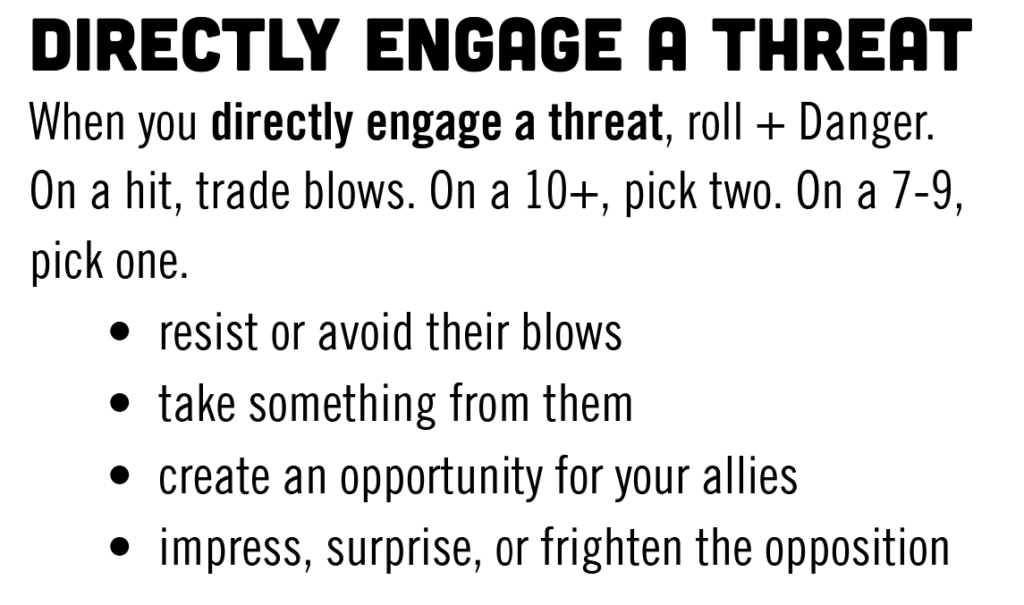
During play, a player might describe their characters doing whatever they want to do, up until the moment they punch a villain (or activate another move). This would trigger the move, pausing narration as the outcome is resolved.
The problem with moves
I’ve run plenty of PbtA games and noticed a trend. Players who are familiar with narrative or role-playing focused games have no problem understanding moves, but players who come from a board game or miniatures game background often really struggle with them. When asked what they want to do, they are left feeling lost in the dark without anything to grab on to, stuck in decision paralysis. And when they ask “what can I do,” “anything you want” is never helpful!
Sometimes these players don’t feel like they have any levers to pull because they are expecting additive design. They expect the game to tell them what the available options are. But even when they understand the concept, the decision space is much, much too large to be tractable!
The problem with moves is that they are a great example of subtractive design, but often they don’t subtract enough.
So what do I mean when I say “additive” or “subtractive” design?
Additive design
“Additive design” is rooted in a core assumption: The player cannot do anything. We add rules to tell the players what they are allowed to do. This is how I conceptualize the design of board games and video games- by default, there are no levers to pull. The game is, in its initial state, a blank canvas with which the player cannot interact in any way.
But if we add a few rules (you may move one piece on your turn, after which your turn passes to the other player. Pawns may move one space towards the opponent’s side of the board, or two on their first move), suddenly the game becomes interactive.
Subtractive Design
“Subtractive design,” by contrast, starts with the assumption that the player can do anything, and then we add rules to remove options. No, you cannot instantly kill someone- you have to roll to see if you can do that. No, you can’t leap over a tall building in a single bound, you can jump about five feet.
This is exactly what PbtA “moves” accomplish- they tell you when to stop and use the rules to resolve something rather than just using logic and group consensus to make decisions.
Thinking about games from a subtractive design lens shows us a major axis on which the feel of a game can vary. A game that has subtracted less leaves more wiggle room for players at the table to make their own decisions. It will feel looser, less crunchy. A game that has subtracted more will feel tighter, more focused, and often heavier and more “crunchy” because subtracting more often requires more rules in total.
We can see the problem that PbtA games often have- without putting enough constraints on player’s decision space, it can leave some players without seeds of ideas to latch onto, or with too many options to pursue.
Blending them together
The reality is that no game is purely additive or subtractive. Board games and tabletop games both need a mixture of both- no matter which starting point they use.
A TTRPG may start by subtracting the entirety of “combat” from the game, before iteratively adding options back in piece-by-piece, like 4th edition D&D.
A board game might start by adding a broad category of options (“you can freely strategize with other players…”) but then subtract some parts of that space (“but you cannot tell any player the exact number or color of any cards in your hand.”)
By recursively adding and subtracting chunks of the action space available to the players, we narrow in on the exact scope of what is permitted and what is not under the rules of the game.
Mistaking additive for subtractive
This is heart of the problem that 4th edition Dungeons and Dragons encountered: Players saw the cards, saw the formal language, and read the design as board game and not role-playing game. In their heads, they switched to interacting with the game from an additive design lens, and it never occurred to them that they had options other than those provided explicitly by the rules!
There’s another pernicious example I’ve seen in a lot of games- and it’s something I’m surprised I haven’t talked about here. Imagine you are building a character for a TTRPG in a modern setting and you see an ability that says: “drive: you can drive a car.”
Before you had seen that ability, you might assume that your character could drive by default. It’s certainly a reasonable assumption! But the moment you see that ability, you know that if you don’t take that ability, your character cannot drive! Likewise, an ability which allows a character to hack into a computer, or perform a flying kick, or shoot a bow and arrow means that all other characters implicitly cannot take those actions!
It can be easy for a designer to forget that they are performing subtractive design and, thinking they are adding a cool option for characters, accidentally subtract an ability from every character unless they have that ability. And when these abilities are balanced against one another mechanically, options that would be narratively interesting often fall by the wayside in favor of mechanically powerful options. And the result is a game where, accidentally, no character knows how to read.
Leave a Reply