Tag: games

  • Carrots and Sticks: Incentives in (horror) TTRPGs

    There’s an adage in economics that seems obvious, but highlights something that’s critically important to understand in game design: “People respond to incentives.” I’ve been thinking about them a lot lately, and while the examples I use here are largely horror rpgs, the lessons are applicable to just about any tone of game.

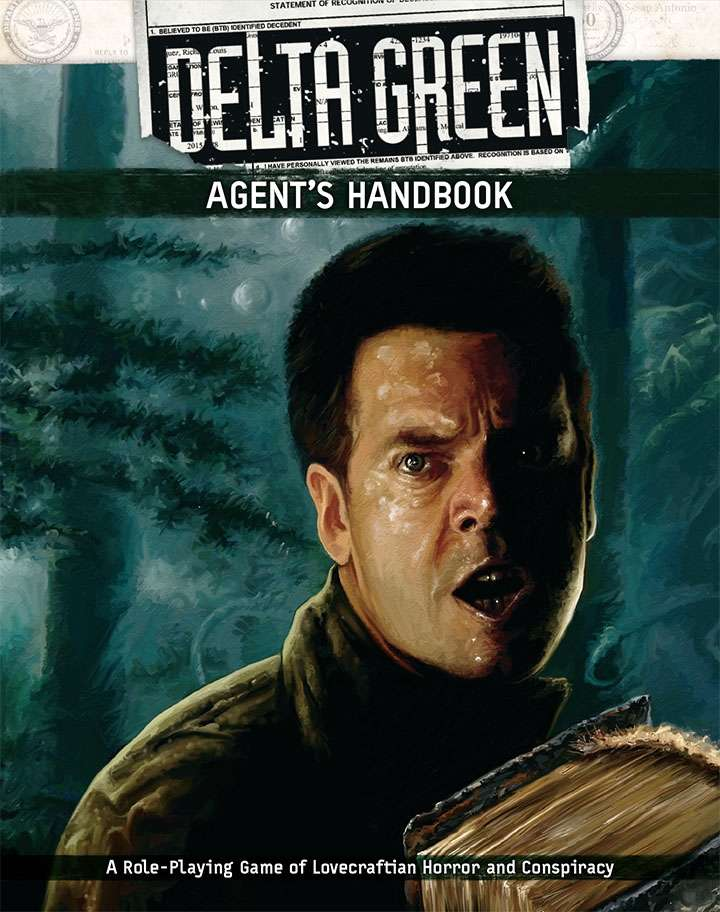
    I had the opportunity to play Delta Green recently, a game inspired strongly by Call of Cthulhu. It was an amazing experience, thanks to a game master dedicated to creating an immersive experience that responded to our characters. It had just enough real-world details to make it feel like something that could plausibly happen. the tension at the table was palpable at times. However, during the game, I noticed something interesting: we were all playing our characters very cautiously.

    The cover of Delta Green Agent's handbook: A role-playing game of lovecraftian horror and conspiracy.

    After the game, I had a chat with the game master about it, and he said he’d noticed that every time he ran the game. It’s hard to tell stories about characters who push through the fear to investigate further, or who do something that a genre-savvy player might know spells their doom. Part of this is because people get attached to their characters and don’t want to see them suffer- which is understandable, but we all knew what we signed up for.

    And yet: we never went into the spooky house, we just burned it down. We never investigated the sounds from below the ground, we just collapsed the entrance. We never learned what was really going on and were happy to get out alive. It was an immensely satisfying play experience… but it was not a good story.

    This isn’t a problem that veterans of this type of game have, or of any hyper-lethal old-school RPG, for that matter. But why is that adage of “drive your character like a stolen car” is much easier said than done?

    There was a trade-off made in the design of Delta Green: Creating the right feeling at the table and making it easy to tell the right kind of story. And to find out why it works out the way it does, we have to look closer at the incentives the game provides to the players.

    What are incentives?

    An “incentive” is anything that motivates someone, for good or ill. Something that spurs someone to action. Incentives make you want something (or want to avoid something). There are broadly two types of incentives, described aphoristically by the phrase “carrot and stick.” If you want someone to do something, you can offer to reward them if you do… or punish them if they don’t.

    Incentives, importantly, always provide a choice. Unlike a rule which says “you must,” incentives always propose “if you do…” (If you take the gold, you will be cursed. If you betray your friends, you will be paid). They’re more subtle than a hard-and-fast rule, however they can be very powerful yet deceptively easy to overlook when designing a game.

    So what were the incentives doing in Delta Green?

    Incentives create a feeling

    Following in the footsteps of “cosmic horror” games before it, like Call of Cthulhu, each character has a pool of sanity points. Whenever a character encounters something frightening, mind-bending, or supernatural, they may permanently lose some amount of sanity points. And while it’s possible to gain them back one or two at a time, you lose them much faster than you could ever regain them.

    This fits the concept that the cosmic horror genre has of sanity- when you know too much of the truth, your grip on reality becomes more and more tenuous, and you can never un-learn what you’ve learned, never un-see what you’ve seen. And if you run out of sanity points, your character is permanently removed from the game. Whether they flee, or die, or just become an NPC under the GM’s control, they are now no longer playable.

    The largest effect of sanity points is the feeling it creates in the players. That feeling that something is being lost that can never be regained. And that feeling instills in the players some of the fear and dread that their characters experience. This is a part of what created that atmosphere of tension and dread at the table that made the moments of release when we made it out all the more cathartic.

    But if it evoked the right feelings, why didn’t it create the right kind of story?

    Feelings create action

    It’s simple, when you think about it: The fear of losing our sanity points made us behave more cautiously. As the economist say, we responded to the incentives. Even though it was our characters in danger, not us as players, we feared losing our characters through the proxy of losing sanity points.

    It might have been a more interesting narrative if we investigated further, but that wasn’t the pattern of play the game incentivized us to pursue. Doing so would be directly against not just the interests of our characters, but against our own interests. If we did decide to look further and our character witnessed something traumatizing, we as players would be punished with the threat of losing our characters!

    But why is this simple thing, ticking down a number on a sheet, so powerful at creating fear in the players at the table?

    The Endowment Effect and Loss Aversion

    People by and large hate to lose things they have. If you give someone $5 and then take it away, they will feel like they have less than they started with. This is known as the endowment effect (or “divestiture aversion”), and it’s a well-studied phenomenon in psychology. People tend to value more highly things they already have than things they could stand to gain, and so letting go of things hurts more than it should.

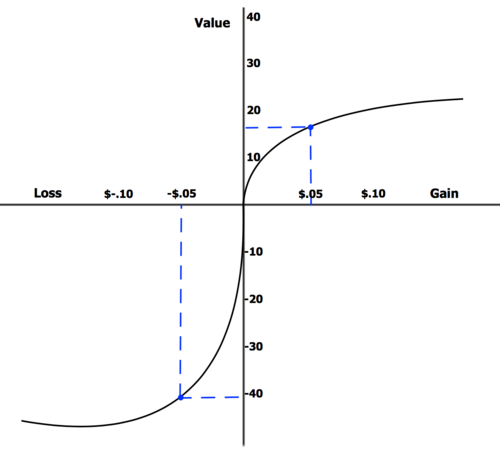
    Likewise, loss aversion tells us the simple truth that people just hate to lose. It feels worse to lose something that it is to gain it in the first place. Losing two sanity points feels more bad than gaining two sanity points feels good, so the outcome is net negative.

    A graph of perceived value of gain and loss vs. strict numerical value of gain and loss. A loss of $0.05 is perceived as having a greater utility loss than the utility increase of a comparable gain.
    A graph of perceived value of gain and loss vs. strict numerical value of gain and loss. A loss of $0.05 is perceived as having a greater utility loss than the utility increase of a comparable gain. (From Wikipedia)

    These psychological effects seem to be very consistent and powerful across numerous studies. This is incredibly useful to us as designers, because it gives us our stick from the “carrot and stick” aphorism.

    It’s clear to see now what was going on in Delta Green. Our fear of losing sanity points made us feel some of the fear of our characters. This created the right feeling at the table, but caused us to act in a predictably over-cautious way.

    Can you have both?

    But is it possible to get both the right feel at the table and the right kind of story? Absolutely! I mentioned previously that experienced players in this genre don’t tend to have this problem. So why is that?

    This is largely because experienced players have learned, after much demonstration, that losing your character is the point of this type of game. It’s inevitable. For many, it’s a lot more fun to enjoy the ride down and go out in a blaze of glory. Or, some might learn to lean into the paranoia and revel in outsmarting the horrors without succumbing to them.

    But it’s generally true that newer players of any TTRPG are much more likely to become very attached to their characters, and experience a lot of painful bleed when their character suffers. By contrast, more experienced players have often learned to separate themselves from their characters more. They’ve experienced their characters suffering, and know that they, as a player, came out ok. And they tend to be more comfortable taking on an authorial role, looking for the most interesting outcome, which isn’t always success.

    And so through focusing on the overall narrative, experienced players can overcome the trade-off and get both a good story and the right feeling at the table. You can feel the fear created by the threat of the stick, but push through it and do the more interesting thing anyway. But is there a way to make it easy for new players to get both?

    Let’s see what happens if we invert the incentives.

    Carrots (and other little treats)

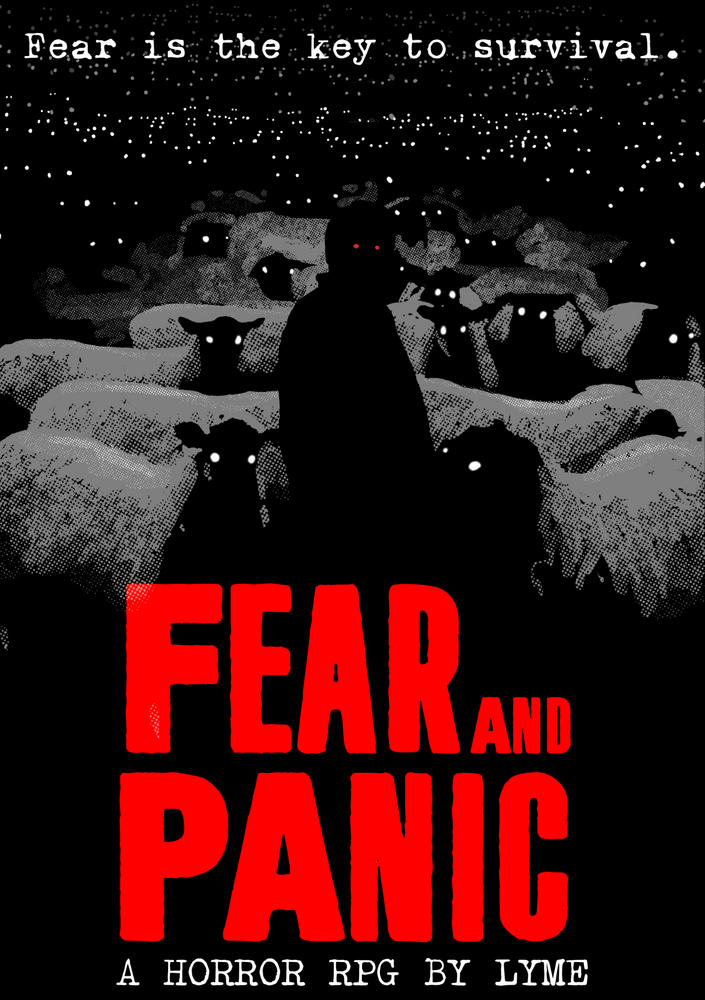
    Fear and Panic, by Lyme is the perfect game to contrast with my experience playing Delta Green, because it almost perfectly reverses the incentives created by the sanity points mechanic.

    The cover of Fear and Panic.
Fear is the key to survival
A Horror RPG by Lyme

    In Fear and Panic, when you see something that challenges your sanity, rather than losing sanity points, you gain fear points. This flips the loss aversion on its head: we’re no longer losing something, we’re gaining something, even though for our characters , the situation is the same.

    And unlike in Delta Green, where running out of sanity points causes a massive punishment -losing your character forever- in Fear and Panic, fear can be spent for bonuses to rolls or to activate special actions… but only for actions that demonstrate your fear or instability like fleeing, lashing out violently, obsessing over a task, or having a prophetic vision. But gain too much fear and you might pick up scars that permanently change your character.

    “A survivor can go the whole game without ever being scared, but with no fear to spend, they may not survive for long.”

    Fear and Panic, p. 14

    Suddenly, it’s easy to imagine as a player wanting to go investigate that sound. Being excited to go into a spooky house in the woods. Because we want those fear points to spend; they just seem fun! So our investigators are suddenly curious, risk-taking, and getting a lot more up close and personal with the horrors.

    But fear points get us both coming and going: once we have the points, we want to spend them. Because we want to succeed, we want the bonuses, so we’re more likely to act in a way that will let us spend the points. And now our investigators are also erratic, self-destructive, obsessive… all the things we as an audience would want to see from a character who’s seen too much.

    Another example:

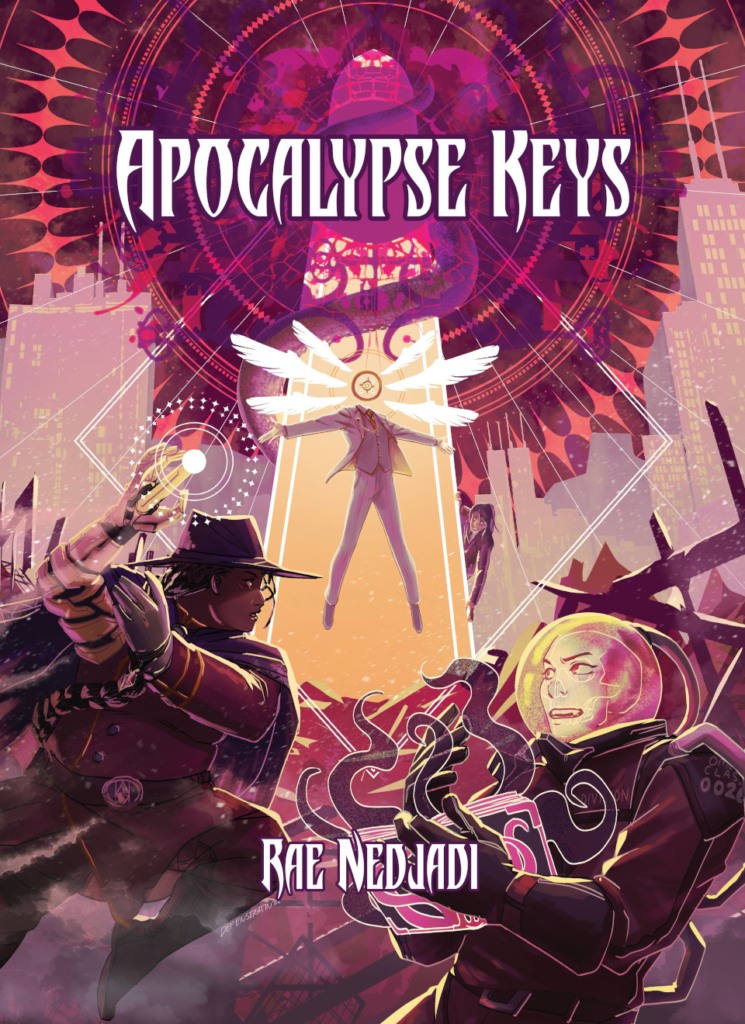
    The only other game I’ve seen that use points so effectively like this is Apocalypse Keys by Rae Nedjadi.

    The cover of Apocalypse Keys

    In Apocalypse Keys, each character contains a monstrous nature that threatens to overcome them. You as a player can earn points by leaning into your character’s monstrous nature- any number of points you want. And you can spend those points for bonuses to rolls. But spend too many and roll too high, you overshoot your target in a destructive way: a “catastrophic success.” And if you hold onto too many without spending them, you risk losing control to your monstrous side, with disastrous results.

    So… can you have both?

    It seems like using something like Fear and Panic completely fixes the problem we have- it’s now easy for players to create a story that matches the genre expectations. But there’s a critical difference in the tone of the game. Where players had been afraid to investigate too closely, now they’re excited. This source of easy tension is gone. And depending on the player, that might be ideal. In a lot of horror games, the goal is not to scare the player, but to scare the characters. But some players might want to be scared, to feel that tension, for the same reason a lot of people love horror movies.

    Fear and Panic addresses this somewhat by making most high-stakes challenges more difficult. So much so that they’re unlikely to succeed without some fear to spend. That fear of failure is a handy motivator, but it’s less powerful that that ticking clock of sanity. Some other games, like Dread, us other means to build tension. (Like a physical tumbling block tower, in the case of Dread).

    But most often, it simply falls to the Game Master. skilled GM can evoke a horrifying tone through skillful narration and writing. Does the ease of pushing players towards their character’s fears rather than away make up for the loss of that feeling of… loss? I don’t know yet. And I’m sure it is different from group to group, but I’m very excited to find out.

    So as before, creating the right tone and the right type of story requires a degree of skill and experience… just this time more from the GM than the players. The game has focused its attention towards structuring incentives to create the right type of story, and less towards creating the right feeling in the players. It’s doing more of its work in a different place, so a different part of the game is easier to run.

    Where does that leave us?

    I am left trying to imagine a game that tries to do both. Would it work as well to build a game where a character loses something meaningful if they don’t go investigate further? Perhaps if you don’t go investigate that noise, you lose more than just an opportunity to find out more. You’re giving in to the way things are. Letting them be. You lose some of your passion. But maybe if you go investigate, you may keep that passion and curiosity, at the risk of physical danger. In this case, we get a game about the fear of complacency, of ennui, of giving up and becoming unimportant to the story.

    For now, it’s just a thought exercise. All of the games we’ve discussed today achieve what they set out to do with flying colors by creating the right incentives. We can create tension and drama by threatening consequences. We can get players to take actions they normally wouldn’t by promising a reward. Even acting against what’s best for their own character for a more interesting story.

    As designers, one of our great powers is to get people to have fun in ways they wouldn’t think to do on their own. Knowing how to create the right incentives and understanding the incentives your mechanics are creating are the key to shaping the experience of the game and the structure of the story.

    Take a look at a any game you have on hand. Pick just about any mechanic and ask yourself: What does this mechanic make me want to do? What does this make seem fun? The answer may often surprise you.

  • Engaging with the Mechanics 2: White space and Green space

    Engaging with the Mechanics 2: White space and Green space

    This is part 2 of my series about making mechanics easier for players to engage with. For the previous part, check out part 1: Cognitive Load

    A few years ago, I sat down with to run Masks: A New Generation with a new group for the first time. After introducing the players to the basic mechanics and making characters, we got started. As things kept rolling along, the hero team confronted a giant robot terrorizing a city park, and I noticed one of the players, a veteran of Dungeons and Dragons, had barely spoken up in the fight. Shifting the spotlight, I asked them directly what they wanted to do to try to stop the robot. They looked at their sheet, at the list of, moves, and back at me, and said:

    “I don’t know. What can I do?”

    This is a difficult spot as both a GM and a player. If you have ever asked your players “what do you do next?” only to get blank stares, you know how this feels. “Anything you want,” is not a helpful answer. In a Dungeons and Dragons style of game, players might have an explicit list of skills and abilities.

    But in a Powered by the Apocalypse game like Masks, your choices are left totally open. Instead, the moves are written to trigger based on the narrative situation within the game. You can’t simply choose from a list, you have to invent a course of action, and then see what move, if any, is most relevant. And to a player used to a more constrained set of options, this wide-open decision space was paralyzing!

    I’ve grown a lot as a game master since then, and in hindsight, I could have done a better job presenting courses of action (the robot is about to stomp on an ice-cream truck! A building nearby is in danger of collapsing!) But this experience is what lead me to recognize a critical difference in design philosophy that has shaped how I design and run games ever since.

    What is white space?

    This space was left blank on purpose

    White space in design is, quite simply, where there is nothing written. Not just blank space on the page (though this may be the case), but also where there are gaps in the rules or setting. You can see this most clearly in any well-written setting book or adventure module. If the designer knows what they’re doing, they’ll intentionally leave gaps for the players (the GM is also a player) to make it their own at the table.

    But in designing rules and systems, it can be a bit harder to notice.

    Out-of-scope whitespace

    There are a few places you can spot white space in a design. The most obvious is around the edges, outside the scope of what the game is about. Because a game or an adventure is finite, there will always be things left out. Deciding what to leave unwritten can be easy: You don’t need sailing rules in a game set in a desert. You don’t need to explain what’s on a continent across the sea in a module set in a single city.

    Sometimes, though, a designer will leave a gap in the design that is surrounded by content. A space where something should be, but there is nothing. And those decisions can be much more difficult, and much harder to use effectively.

    So why do we do it? And why is it so important?

    Why leave it blank on purpose?

    We hammer wood for a house, but it is the inner space that makes it livable

    Tao Te Ching, translated by Stephen Mitchell, chapter 11

    The high-minded philosophical reason

    When designing a game, it’s easy to take on the view that the rules are the game. That the players at the table will execute on the rules, and in so doing, experience the game as intended. But there’s something fundamental missing from that perspective.

    I mentioned previously that white space lets players tune a setting or a game to their individual group and preferences. But that’s something of an understatement: White space is what is unique about tabletop role-playing games. Without it, you have not created a tabletop role-playing game; You’ve created a board game. It may have random elements, or choices to make, but every option would be proscribed.

    Rules in TTRPGs are different from rules in a board game. Rules are generally clear and rigid, but TTRPGs are flexible and open to interpretation by design. It’s not the rules that are the game, it’s what happens in-between the rules. It’s the conversation.

    The rules in a TTRPG are not a merely set of steps to execute, they are sturdy skeleton that supports the wobbly organic bits in-between. They are a vessel that shapes and contains the fluid conversation that pours out of the players.

    The blank space you leave within your game is what defines the shape of the game. The part of the game that is not written in the book is the part that is played. And discovering what fills that empty space is a large part of why we play.

    Your job as a designer is to structure the conversation so that engaging with it will create the experience that you’re inspired to share

    Nathan D. Paoletta, RPG Design Zine

    Example: Character sheets

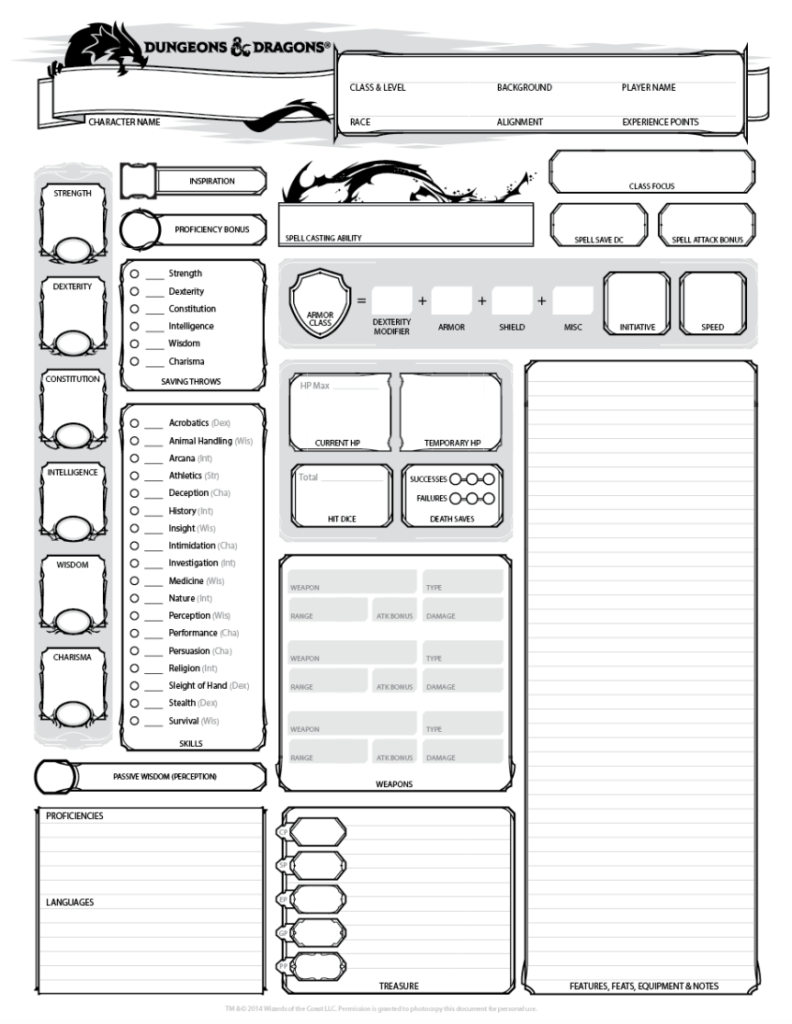
    For a concrete example, think of the spaces that are blank on a character sheet:

    The official Dungeons and Dragons 5e character sheet.
    Look how much of this sheet is just lined paper

    The name, stats, abilities, these are all degrees of freedom in the design of a character because they are left blank on the sheet. But even there, there are rules for how those are to be filled in. But look closer on many sheets and you will see something that doesn’t have rules associated with it: a box with lines for notes, character details, backstory, personality, and so on. Things that go beyond and between the rules to explain why and how this character is the way they are.

    Even on sheets that don’t have this feature, (Powered by the Apocalypse games are frequently guilty of this), I’ll see players adding notes into margins, the back of the sheet, or even a separate page that explain the details of their character that aren’t enforced or even supported by any game system.

    This blank space is what lets a player feel they own and inhabit a character. Even games have characters already defined for you, like Yazeeba’s Bed and Breakfast, have blank space to fill in as you explore the characters through play.

    The Practical Reasons

    Well-crafted white space is in ttrpg design has very practical benefits:

    White space allows for customization. While choosing from a list is quick and easy, there’s nothing that provides more freedom in a design than allowing a player to make up whatever they want (within reason & the bounds of the game) to fill a space. Like with character sheets and settings as described above, when something is left unwritten by the designer, it falls to the players to write it. And the players at the table can often (but not always) come up with an answer that is better for their specific table than a designer trying to make an answer that works for every table could.

    White space gets buy-in. When you’ve had the chance to create part of a character, the world, or part of the game system, you naturally feel a sense of ownership over it. You’re intimately familiar with that part of the game because you had a hand in creating it. You feel authority to make decisions about that part of the game. You feel invested in seeing what happens to it next. This is why collaborative worldbuilding at the start of an RPG is so powerful, but it can work the same magic in so many other places.

    White space gets you thinking. There’s something compelling about the space on the map that just says “here there be monsters.” The thrill of curiosity and discovery is a huge part of what drives people to play TTRPGs. Just like I mentioned about customization above, the blank space naturally prompts players to imagine what could fill that space. What could possibly explain everything surrounding that gap? To use Blades in the Dark as an example, Lord Scurlock is presented as a mysterious, seemingly-immortal figure whose personal influence is so powerful that he is on an even playing field with some of the most powerful factions in the city. But exactly what he is or what he wants is left totally ambiguous. As a result, the players almost always want to find out, and the GM gets to have fun crafting his sinister plot. As a result, everyone at the table is engaged.

    Putting it all together

    There’s a rule in horror that the moment you show a monster to the audience, it instantly loses its emotional power over them. When you can’t see it, you’re forced to imagine what it could be. And what each individual imagines is going to be more powerful than anything a writer could come up with or an artist could create.

    As long as the space is left blank, the audience/player is compelled to engage, to imagine what could be there. Everyone has their own monster, and the monster can be different every time. That’s the magic of white space.

    The Catch

    Unfortunately, there’s a big problem with white space. It turns out, can sometimes be really hard to think of an idea on the spot that’s as cool and interesting as you’d like. Sometimes, it feels like breathing. There’s an obvious answer, or, even better, one that violates expectations in an exciting way. But sometimes it feels like being thrust into the spotlight on stage without knowing any of the lines. Like sitting down for test without studying.

    Experience helps, but the experience is still highly variable even for the most skilled improvisers. So why is it sometimes so stressful, but sometimes it feels so natural?

    Planting seeds: How make white space green

    The secret to making white space work is planting seeds. Prompting players so that by the time they’re asked a question, they already have ideas for the answer. Immersing them in the vibes of the game. Showing them the shape of the gap in the puzzle so they know how to craft the missing piece.

    This is green space. Rather than a barren field, the blank space is crafted into fertile soil for ideas to grow. What might look like an empty field actually has seeds of ideas already planted under the surface.

    Example: For the Queen

    The best example of this I’ve ever seen is For the Queen, by Alex Roberts. For the Queen takes the form of a set of cards, each of which has a simple prompt. It begins with the players being told “The queen has chosen you for this mission because she knows you love her.” Players take turns going around the table drawing a card and answering the prompt on it. At the end of the game, everyone responds to the prompt: “The queen is under attack. Do you defend her?”

    I was deeply skeptical of this game when I first heard that premise. Surely, I thought, if the cards are the same, even in a different order, the game would play out largely the same way every time! But I could not have been more wrong. Even though the seeds planted by the designer are the same every time the players sit down to play, they will grow differently every game.

    I had overlooked an important part of the game. I hadn’t noticed what was missing: For the Queen has zero character creation. The characters are completely blank at the start of the game. Even the eponymous Queen, though you may have a piece of art to inspire you, is a totally blank slate. As I said in a earlier, the part of the game that is unwritten is what part that is played. The characters are left blank, so the game is about discovering who they characters are.

    But how does this work? How could you create a character from a completely blank slate with no rules to guide you? When designing the prompts, Alex Roberts had the mantra: “Tell them something they don’t know, then ask them a question about it.” That simple mantra is an incredibly powerful tool for game design, and it’s the secret to making white space into green space.

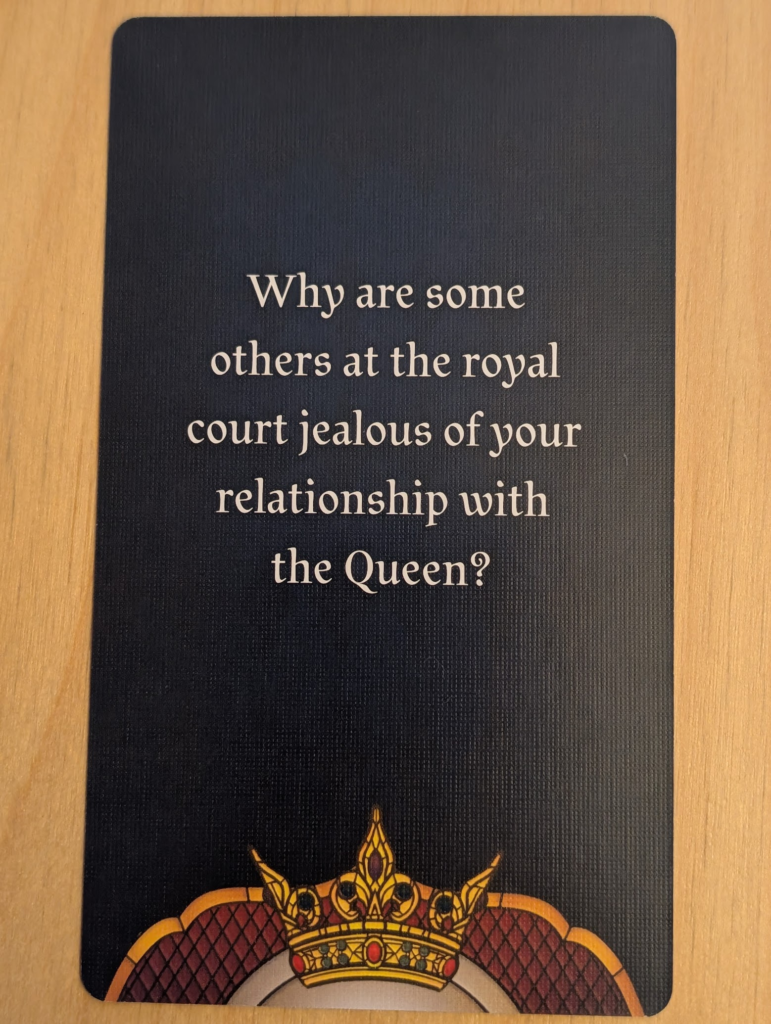
    Why are some others at the royal court jealous of your relationship with the queen?
    A sample card from For the Queen

    For example, the prompt on this card might look totally open-ended at first, but it actually tells you a great deal: You have a special relationship with the queen, it is known to others, and those others are envious of that relationship, so it must be worthy of envy. But it doesn’t tell you anything about what that relationship is.

    The card above brilliantly hides the prompt within a question. It buries the seed, making the hand of the designer invisible while constraining the space of answers to the question. The player no longer has to decide if the relationship is good or bad, or if it’s secret or public. The prompt feels completely open. But when the player starts to answer that question, their answer will naturally fall within the constraints created by the premise of the question. The result will feel as though it is completely their idea.

    And yet the player is never alone in crafting their answer to the prompt. They’re guided by the prompt, by the previous answers they’ve given, and by the very premise of the game (the Queen chose you because she knows you love her, after all).

    Consider the alternative cases:

    • What is your relationship with the queen?
    • Some others at the royal court are jealous of your relationship with the queen.

    In the first case, the question feels absolutely impossible to answer, especially if it’s the first card you draw! It’s so wide open, there’s nothing to latch on to. There’s no seed crystal to grow your idea off of.

    But in the second case, a player would likely feel they’re being dictated to. This is the way it is- no room for debate! Simply accept the premise and move on.

    But when both are put together, the magic happens.

    The takeaway: Ask leading questions

    The secret is leading questions. I was first introduced to the power of this idea at a seminar at GenCon, and it’s totally changed the way I GM. Whenever you have the chance to ask an open-ended question, you can gently constrain the answers to prompt the other players with ideas for how to answer. If you practice this skill, it will make your a better designer and a better game master.

    This instantly fixes the “what do you do next?” problem. To steal an example from that GenCon seminar, instead of asking “what do you do next” until the plot advances, decide on something that would advance the plot, and ask the players a question about that.

    Instead of “what do you do before the party,” ask “How long do you wait before arriving at the party? How do you get there?” Is this railroading? No. Because players love to be contrarian, and just as easily as it might prompt the players to answer the question you asked, it might prompt them to say “what if we don’t show up at all?” But that answer still moves the narrative forward.

    In the Masks example I gave right at the start, I might have said: “The robot is barreling out of control towards a group of civilians. What do you do to stop it?” The player might choose to prioritize something else, but by doing so they are making a major decision about the direction of the narrative.

    No matter the situation, tell them something they don’t know, then ask them a question about it.

    Expert mode: Begging the question

    A leading question doesn’t necessarily have to be a literal question. In fact, the most challenging but rewarding way to make this happen is to get the players to ask the question themselves. To make this work, you have to beg the question.

    To make this work, you need two things:

    Craft a compelling hook. Present the players with something so compelling and mysterious that they simply must engage with it. Enough details that they can easily imagine what might go there. This is the seed that the players’ ideas will grow from

    Then, resist the urge to explain. It’s so challenging as a designer to leave those spaces blank because we get pulled by our curiosity to fill it in just as strongly as the players, if not more. But you need to leave enough blank space to fit a wide variety of options.

    For example, in Wanderhome, by Jay Dragon, one of the items the Ragamuffin could start with is “The Heavenblade, lost after slaying the Slobbering God, that you would never use to hurt another soul.” This immediately prompts questions: What is the Heavenblade? What was the Slobbering God? How did you of all people end up with it?

    If you fill your game with interesting hooks, but leave them unexplained, like the horror movie monster, players will be compelled to imagine what fills that space. And whatever they come up with will be better for them in that moment than anything you could write.

    This is how you plant seeds. This is what makes your white space into green space.