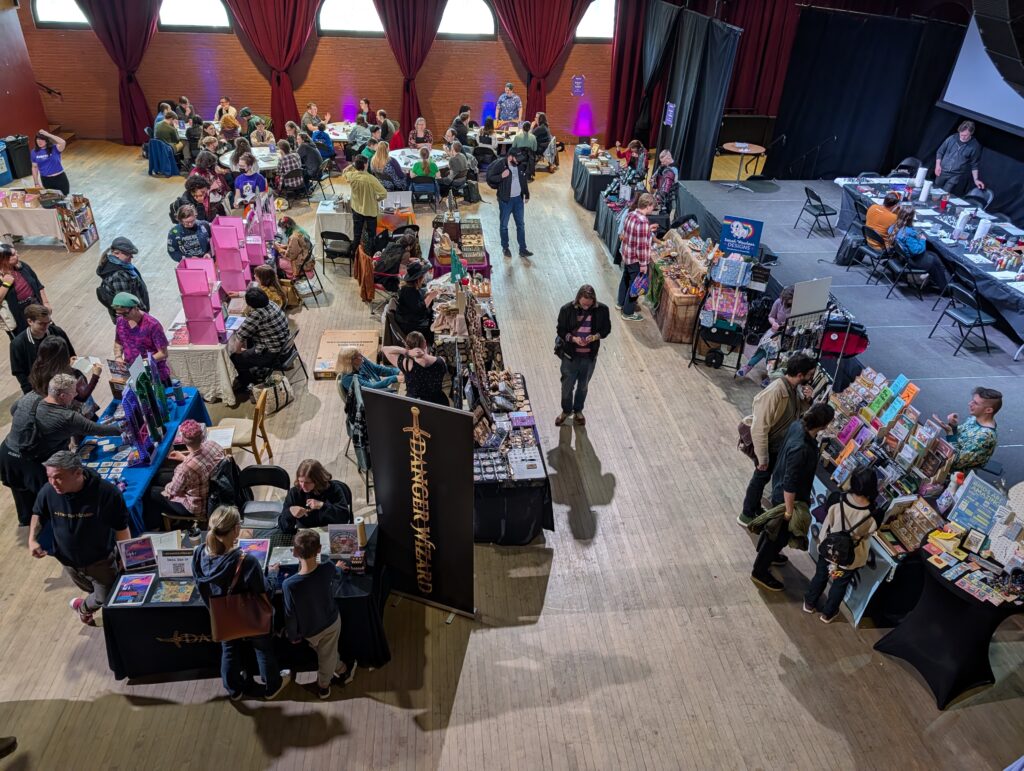
This month has been relatively slow for Far Lands progress, as my passion has been pulled a lot of different directions by side projects, but I have made one major step I’ve been planning for a while: I’ve reached out to a cultural consultant.
This is something I’ve intended from the very beginning, but I’ve been nervous to take that leap. I am very aware of the troubled history of “exploration” in the real world and in games, and I know it’s had an invisible influence on my work. I’m not trying to make my game universally palatable- rather, I want to discover how this history has affected me and my work, and work to avoid perpetuating the harmful cultural narratives.
I still have a lot to learn, but this post is dedicated to what I have I learned so far.
Terra Nullius
One of the earliest decisions I made in Far Lands was that I didn’t want it to have a large component of interacting with native peoples- the real world history of exploration made that very fraught, and it is imperialist in the extreme to imagine an “uncharted land” that already has people living there!
However, this introduces an opposite problem: “Terra nullius” is a phrase that describes the false image that a colonized land was totally uninhabited before settlers arrived. By forbidding the possibility of encountering native peoples, I risk reinforcing that myth that erases the atrocities commuted by real-world colonizing forces. in the real world, people already lived almost everywhere long before ships were crossing oceans.
Explore, Exploit, Expand, Exterminate
There is a genre of game known colloquially as the “4X” game. The four X’s stand for the heading of this section – Explore, exploit, expand, exterminate.
Nearly every “exploration” game is really about finding resources to exploit, land to claim and settle (expand into), and enemies to exterminate. It’s not hard to see the fraught history that this glorifies! The latter three are almost always the core motivation for the first, and it is difficult to shift away from that motivation as there is so much cultural tradition built up around this type of narrative.
Instead, I have tried to design Far Lands focus on creating interesting questions and exploring to find the answer, pursuing curiosity rather than personal or imperial gain. But it is hard to unlearn those colonial narratives, and I worry those themes have infiltrated the example scenarios I provide.
Reducing a region to a map with fixed borders and names has long been a tool of imperial colonialism. Historically, explorers and imperial powers have used cartography to assigned names to things that already had names, to draw borders around things, to stake a claim to land on paper that they had no tangible claim to. Being the first to discover something (or claiming to be first) comes with a sense of ownership- figuratively or literally planting a flag. Expanding the bounds of the known world comes hand-in-hand with expanding the borders of empire.
To that end, I tried to design the game to always leave more unexplored than you can pin down concretely. There is always blank space left on the map, always things you can see in the distance that you can never physically enter. The map is never “done.” And I never ask the players to name anything. Of course, you can name regions if you want, because it can be fun and harmless, but naming the thing is not really what the game is about.
Faith and the sacred journey
I have noticed over the course of designing the game that the roles I offer to players to build their explorers are powerfully influenced by my own background. In particular, being raised in a very mono-cultural New England town has limited my imagination when it comes to representations of faith.
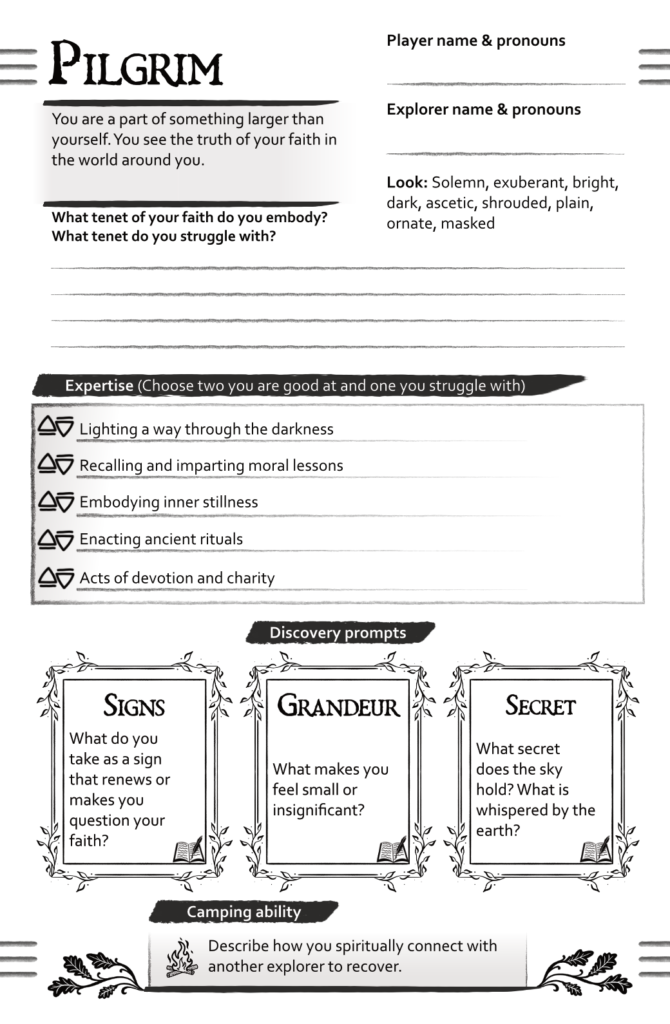
When I added the Pilgrim role, I looked back at it and was very dissatisfied with it, because the initial draft felt so tied up in my own background. It didn’t feel like it could be used to represent versions of faith very different from what I saw growing up. There was a push and pull as I revised it, along with the Seer, Lore-Keeper, and Evoker roles. I wanted to make them broad enough to represent a wide variety of histories, faiths, and magic practices, but still have enough flavor and specificity to spark ideas.
When I had the chance to speak with the folks at Open the Gates Gaming, though, we realized I’d already done something really powerful. Because each explorer is made up of two role sheets, a very wide range of faiths is represented by virtue of the other role sheet a character has. Is a character a Pilgrim / Crafter? Then perhaps the faith has a focus on craft. A pilgrim / seer may have a very spiritual faith, where a pilgrim / mentor may be focused on forging connections with others.
I know there’s more I can do, and more I can learn. I was nervous diving into this part of the journey because I was afraid of being wrong. I was afraid that I had been doing the wrong thing for a long time and hurting people without realizing. I was afraid that it would be difficult to unlearn these narratives that have been so ingrained in us from birth.
But what it has revealed to me is profoundly exiting. Being able to question the default path has let me find a lot of exciting new directions to explore that I wouldn’t have considered. I also don’twant to just blindly do the thing that so many other games an stories do because I want to make something new. And by making a game with sensitivity to the historical harms that come with this genre, I can welcome into it folks who would otherwise have been excluded.
Learning to question assumptions that I had previously taken for granted has allowed me to explore what happens if I change those assumptions, and it’s unlocked design spaces that I hadn’t previously seen. And I couldn’t be more excited to see what lies down those paths.
Recently I was in the office chatting with some work friends about TTRPGs. During the discussion, one of the biggest philosophical differences in how people approach TTRPGs came up: “narrativist” players vs “gamist” players. This is a distinction that dates way back to the Forge days of design with something called “GNS theory.” You can find a pretty good explanation of it here. GNS theory also had a third axis- “simulationist,” but I’m going to put that aside for now. The important distinction is players approaching role-playing games “role-playing” first or as “game” first. And depending on which tradition a player comes from, they may encounter two very similar problems but from opposite sides.
Let’s look at two games for comparison: Apocalypse World and Dungeons and Dragons 4e.
Dungeons and Dragons 4th Edition
Dungeons and Dragons 4e was a major departure from previous versions. Gone was the asymmetry and unique mechanics for each class. Now, each class simply defines which pool of “powers” (often printed on cards) a character could select from. Every “power” had a formal, structured syntax that, once you got over the steep initial learning curve, would unambiguously describe the effect of the power.
Despite their symmetry, each character felt extremely unique, because the way the unique powers of a given class interacted was tuned for the style of play that class was intended to evoke. It was a tremendously elegant system, which was a major inspiration for the power cards from the more recent Daggerheart from Darrington Press.
However, the system was very poorly received, for a few reasons. The lesser-known is that the math was simply broken on release. The formula used to calculate health and damage numbers for monsters in the first monster manual resulted in enemies that had far more health and less damage than intended, resulting in fights that felt like a slog.
The problem with ability cards
The real break for most players came from the power cards themselves. A huge swathe of players built their first character, excited by the options before them, sat down at the table, and… didn’t know what to do with them. They looked at the power cards and realized none of them were really useful in this situation… so they didn’t have anything to add to the scene.
The reason for this seems clear when you look at the distribution of the kinds of effects the power cards have: The vast, vast majority of them are only usable during combat. While each character got a few “utility” powers, they were scant compared to the combat abilities!
But if you actually look closer, you’ll find a robust skill system very similar to what many players enjoy in 5th edition today. But because players had a fistful of cards saying what their character could do, it naturally lead to the unconscious assumption that their character could not do anything else. It felt as though the powers were a list of the the options a player could choose from. As a result, players were left feeling like the game had no support for free-form role-playing.
The form factor of the game lead players to assume an additive design paradigm that was not actually intended by the designers. But before I explain what I mean, let’s talk about our other example:
Apocalypse World
Apocalypse World is a familiar name to anyone in the indie RPG scene right now- it spawned a million spin-off “PbtA” (powered by the apocalypse) games thanks to its elegant and innovative system for easily building narrative themes and style into the mechanics of a game.
The core unit of play in Apocalypse World that is relevant is a “Move.” A move has two parts- a trigger and an effect. In D&D 4th edition a player chooses a power to activate and then describes what it looks like. But in PbtA games, players and the GM describe whatever they want to conversationally until they satisfy the conditions to trigger a move. Once they do, they resolve the effect, which often but not always involves rolling dice and/or choosing from lists, then return to free-form play.
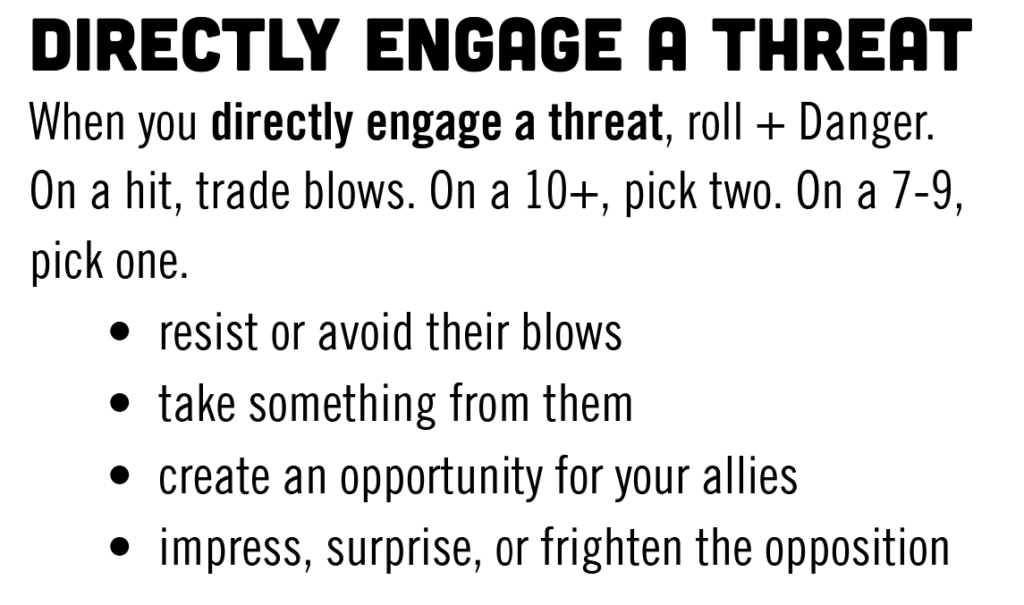
A “move” is any situation where the rules of the game intervene in the free-form role-playing. Usually, this covers places where the outcome of an action is uncertain, but it can also cover specific triggers for deterministic outcomes. For example, Masks: A New Generation has the move “Directly Engage a Threat”:
During play, a player might describe their characters doing whatever they want to do, up until the moment they punch a villain (or activate another move). This would trigger the move, pausing narration as the outcome is resolved.
The problem with moves
I’ve run plenty of PbtA games and noticed a trend. Players who are familiar with narrative or role-playing focused games have no problem understanding moves, but players who come from a board game or miniatures game background often really struggle with them. When asked what they want to do, they are left feeling lost in the dark without anything to grab on to, stuck in decision paralysis. And when they ask “what can I do,” “anything you want” is never helpful!
Sometimes these players don’t feel like they have any levers to pull because they are expecting additive design. They expect the game to tell them what the available options are. But even when they understand the concept, the decision space is much, much too large to be tractable!
The problem with moves is that they are a great example of subtractive design, but often they don’t subtract enough.
So what do I mean when I say “additive” or “subtractive” design?
Additive design
“Additive design” is rooted in a core assumption: The player cannot do anything. We add rules to tell the players what they are allowed to do. This is how I conceptualize the design of board games and video games- by default, there are no levers to pull. The game is, in its initial state, a blank canvas with which the player cannot interact in any way.
But if we add a few rules (you may move one piece on your turn, after which your turn passes to the other player. Pawns may move one space towards the opponent’s side of the board, or two on their first move), suddenly the game becomes interactive.
Subtractive Design
“Subtractive design,” by contrast, starts with the assumption that the player can do anything, and then we add rules to remove options. No, you cannot instantly kill someone- you have to roll to see if you can do that. No, you can’t leap over a tall building in a single bound, you can jump about five feet.
This is exactly what PbtA “moves” accomplish- they tell you when to stop and use the rules to resolve something rather than just using logic and group consensus to make decisions.
Thinking about games from a subtractive design lens shows us a major axis on which the feel of a game can vary. A game that has subtracted less leaves more wiggle room for players at the table to make their own decisions. It will feel looser, less crunchy. A game that has subtracted more will feel tighter, more focused, and often heavier and more “crunchy” because subtracting more often requires more rules in total.
We can see the problem that PbtA games often have- without putting enough constraints on player’s decision space, it can leave some players without seeds of ideas to latch onto, or with too many options to pursue.
Blending them together
The reality is that no game is purely additive or subtractive. Board games and tabletop games both need a mixture of both- no matter which starting point they use.
A TTRPG may start by subtracting the entirety of “combat” from the game, before iteratively adding options back in piece-by-piece, like 4th edition D&D.
A board game might start by adding a broad category of options (“you can freely strategize with other players…”) but then subtract some parts of that space (“but you cannot tell any player the exact number or color of any cards in your hand.”)
By recursively adding and subtracting chunks of the action space available to the players, we narrow in on the exact scope of what is permitted and what is not under the rules of the game.
Mistaking additive for subtractive
This is heart of the problem that 4th edition Dungeons and Dragons encountered: Players saw the cards, saw the formal language, and read the design as board game and not role-playing game. In their heads, they switched to interacting with the game from an additive design lens, and it never occurred to them that they had options other than those provided explicitly by the rules!
There’s another pernicious example I’ve seen in a lot of games- and it’s something I’m surprised I haven’t talked about here. Imagine you are building a character for a TTRPG in a modern setting and you see an ability that says: “drive: you can drive a car.”
Before you had seen that ability, you might assume that your character could drive by default. It’s certainly a reasonable assumption! But the moment you see that ability, you know that if you don’t take that ability, your character cannot drive! Likewise, an ability which allows a character to hack into a computer, or perform a flying kick, or shoot a bow and arrow means that all other characters implicitly cannot take those actions!
It can be easy for a designer to forget that they are performing subtractive design and, thinking they are adding a cool option for characters, accidentally subtract an ability from every character unless they have that ability. And when these abilities are balanced against one another mechanically, options that would be narratively interesting often fall by the wayside in favor of mechanically powerful options. And the result is a game where, accidentally, no character knows how to read.
I’m excited to announce that I’m going to be hosting a few sessions of Far Lands at GenCon this week through Games On Demand! Find me at the Westin Hotel in Grand Ballroom 3 on the second floor, near the convention center skywalk.
I’ll be facilitating two sessions: One from 4-6 on Thursday and one from 2-4 on Friday. I couldn’t be more excited, and I’m grateful to the folks at Games On Demand for the opportunity!
Stream VoDs
Miss the streams of Far Lands that I did with Open the Gates Gaming I did a few months ago? The full recordings have been uploaded to their youtube channel:
Part 1
Part 2
A huge thank-you to Matt, Sean, Chris, Atlas, and the rest of the team over at OtGG! It was an absolutely amazing experience and I’d love to return to the world we created any time.
Far Lands Layout Update
With the full book (roughly) laid out, now it’s polish time- commissioning a few final pieces of art, revising layouts to increase readability and make better use of white space, copy-editing. I’ve printed test pages that I’ll be using as reference at GenCon, and I expect that convention season will get me a lot of momentum on the next draft!
It’s starting to get towards time to think about the logistics of crowdfunding, which is… terrifying. But exciting! Much more exciting news to come.
I was at a local game designer meetup recently talking about something I was struggling with in Far Lands. On every character sheet was a section of gear they carried. I’d been asked for that specifically by multiple playtesters, but just couldn’t seem to make it feel right. One of the designers, I wish I could remember who, gave me the best pieces of advice I’ve gotten for my game design recently:
“Identify the fantasy of the game. What player behaviors would support that fantasy? Does that part of your game contribute to the fantasy or create those behaviors? If not, cut it.”
And I realized that of course, no. This isn’t a game where inventory matters. So I cut it.
But why doesn’t it matter?
When would it matter?
Tracking exactly who’s carrying what might matter in a very different game. In His Majesty the Worm, what you’re carrying in your hands, on your belt, and in your pack really matters. The fantasy is all about moving carefully through a dark and dangerous dungeon, so who is carrying the backup torches might be a matter of life or death.
And yet in any other system, I’ve rarely played or run a game where exact amounts of rations, torches, or arrows was tracked at all. Why does it matter so much in one game and not in another? Because in his Majesty the Worm, the exact contents of your inventory matter.
The game delivers a different fantasy, where it might be the difference between life and death if an item is on your belt or in your backpack. And the other mechanics connect to it directly: each slot in your inventory is numbered so events can target random inventory slots.
Why doesn’t it matter?
On my blog I’ve been talking about the reasons players might not engage with mechanics. One I see time and time again is that the mechanic just doesn’t seem worth it. It doesn’t have any mechanical effect, it isn’t connected to the rest of the system, it just doesn’t matter.
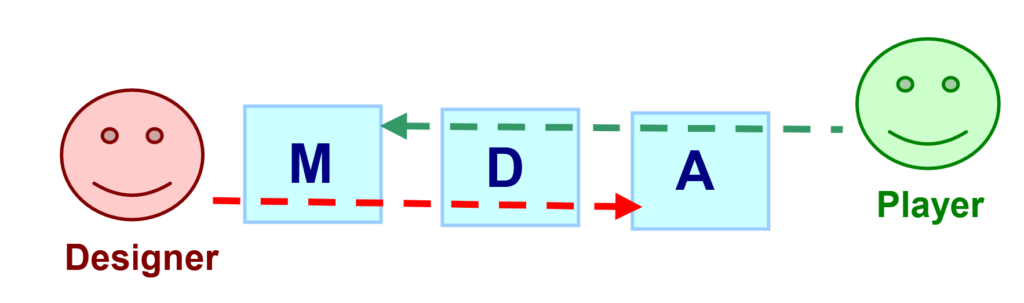
It turns out, there’s a convenient theoretical framework that shows us exactly why. MDA is a framework for game design and analysis in which, games are broken down into three layers: Mechanics (what do the rules instruct you to do), Dynamics (what behaviors do the mechanics create), and Aesthetics (what feelings or experiences does the game create). Mechanics that aren’t worth it are a disconnect between those layers.
MDA: A Formal Approach to Game Design and Game Research (Hunicke, Leblanc, Zubek)
Take for example tracking ammunition in D&D 5e. It’s a relatively simple thing to execute, not any different from tracking spell slots really. But even if it’s actually applied, it barely changes the dynamics, and it doesn’t contribute to the fantasy of the game.
Let’s identify the fantasy of the game (the aesthetic, in MDA terminology). This will vary from table to table, but the most common way that people play D&D 5e is as a cinematic, heroic game. It wouldn’t do for an epic hero to run out of arrows, unless it was at a dramatically appropriate moment! Most games… Just aren’t interested in that happening. It doesn’t contribute to the aesthetic! And so the mechanic is ignored.
But how does it connect to the dynamics? That’s a more complicated matter. Perhaps it might make a player choose to conserve their resources and use melee options more than they otherwise might. But in practice, it most likely just means a few seconds of extra logistics buying arrows when the party returns to town. It does have a mechanical effect- when you run out of arrows, you can’t use your bow anymore. But what if it didn’t?
Intangible mechanics
Some rules don’t seem to actually have “mechanical” effects at all. An episode of Dice Exploder podcast I listened to recently described these as “intangible” mechanics. In the episode, Sam Dunnewold and Alex Roberts discuss “pity points” from Kagematsu. The game never tells you to do anything with them, but they affect the game in a myriad of subtle ways. Because pity points and their counterpart, love points, are awarded secretly, their existence conceals whether the player actually received a love point or not.
But perhaps more importantly, the fact that they are described as “pity” points dramatically changes the feeling of playing the game (the aesthetic), and, consequentially, how the players engage with it (the dynamics). Give the episode a listen to hear more about it!
These mechanics feel “intangible” because they don’t connect to the other mechanics. Instead, they connect to a higher level of the MDA framework: directly to the dynamics or aesthetics.
Another excellent example of an “intangible” mechanic discussed in the Dice Exploder episode is “contempt tokens” from The Quiet Year, by Avery Alder. In The Quiet Year, a player can take a contempt token whenever another player starts a project or resolves something in a way that they disagree with. Players may return tokens when someone acts selflessly or diffuses tension in the community.
The tokens themselves have no effect, but at some tables, their influence on the game can be undeniable. It’s a marker of conflict in the community, a reminder that there is tension to be diffused. The act of taking a token, the presence of the token, and the act of returning the token all change the emotional charge at the table and in the world of the game (the MDA aesthetic). This change in how the game feels in turn changes how people play (the MDA dynamics).
Using intangible mechanics
This perspective has changed how I think of rules. In a previous blog post, I talked about how incentives can affect the game-feel and play patterns in ttrpgs. While these incentives can be tied to other mechanics, they don’t actually have to be in order to have the same effect.
This is what inspired how I use conditions in Far Lands in my original design, each condition had a unique effect. In playtesting, players couldn’t remember what they were, so I simplified it and made every condition the same. But if they were all the same, I started to wonder why it mattered that they were different at all.
Looking deeper, I realized that the names of the conditions being different was what made their effects different. Even if they were mechanically the same. In fact, they didn’t need a “mechanical” effect at all!
Merely telling the players “you are exhausted” or “you might become injured” had exactly the desired effect. It changed the ways people evaluated the danger level of challenges, the way they described their approach, the way they moved through the world and made camp.
Even though conditions don’t do anything, they still matter. They give impact to the complications explorers encounter. They make challenges feel risky because of the chance of complications. The stakes feel real, and that changes how people play.
No matter how a challenge resolves, there’s no change to the gameplay. But the conditions change to how the gameplay feels and how the players behave.
What can go wrong?
Intangible mechanics like this can be subtly powerful. They can have a dramatic effect on gameplay and game-feel without a significant amount of cognitive load (something I discussed in a previous blog post). But they are equally risky. Players might not see the benefit of the mechanic if it isn’t obvious what it does. It might seem like it doesn’t matter, and be ignored.
I can see a group asking: if conditions don’t do anything, why are we bothering to mark them? And if we aren’t marking conditions, why are we checking to see if we get a complication? If we aren’t checking for complications, why are we marking stress? Why do we have to overcome a challenge?
By pulling this thread, the entire game unravels. When we remove one intangible mechanic, the other parts of the game that lean on it become intangible themselves.
It’s ok if a rule is strictly narrative, or doesn’t seem to serve a purpose at first glance… if it reinforces the themes of the game or the behavior that makes the game work!
If you missed it, catch the VoD of part one of my Far Lands streams with Open the Gates Gaming here. The video will be available on Twitch for two weeks, after which I’ll post a link to the video on their YouTube page.
Catch us live on twitch next week on Thursday July 2nd at 8:00 PM EDT when we jump into exploring the world we created!
This stream has really reinvigorated my passion for Far Lands, reminding me of what I love and how far it’s come. I’m so proud of what I’ve created and I couldn’t be more excited to continue to share it with the world.
With that said, I’d love to share a bit of something else I’ve been working on.
Parallel development
One of the strategies that has kept up my passion for Far Lands has been letting myself take breaks. I almost never have only one project running in parallel, and when I sit down to work, I will tend to be much more energized if I spend that time working on whatever I’m excited about in that moment.
Of course, it isn’t perfect. It’s lead to periods of stagnation on Far Lands when there was a particularly unpleasant hurdle to get over. But often I find that time away from my main passion project gets me itching to dive back in. And that will get me the momentum I need to get over the hump.
This leads to a lot of unfinished work- but none of them are dead ends. Many of them have bits and pieces I repurpose elsewhere, or will eventually lead to something further down the road. But some of them I’m really proud of, and I want to develop my confidence sharing those things that don’t feel “ready” yet.
Running Politics in TTRPGs
I’ve always wanted to run games with more intrigue. Political scheming, backstabbing, and emotional stakes rather than physical peril. But most mainstream ttrpgs make this exhausting, requiring either the GM does a huge amount of work to set it up from scratch and make it play as intended, or requiring an enormous amount of tracking minutiae.
This is a project that started in parallel with Carpe Omnis games after we talked about this problem at convention one year. We’ve both noodled around with our own versions independently, come together to work on a collaborative version, and then spun off to work on our own parallel versions again a few times now.
Every revision was very much a response to whatever game I was excited about at the moment. Building and rebuilding the systems without ever actually playtesting anything. To this day, I still haven’t actually played any variation of this game!
The latest version is based off of Hillfolk, by Robin D. Laws.
The Prototype
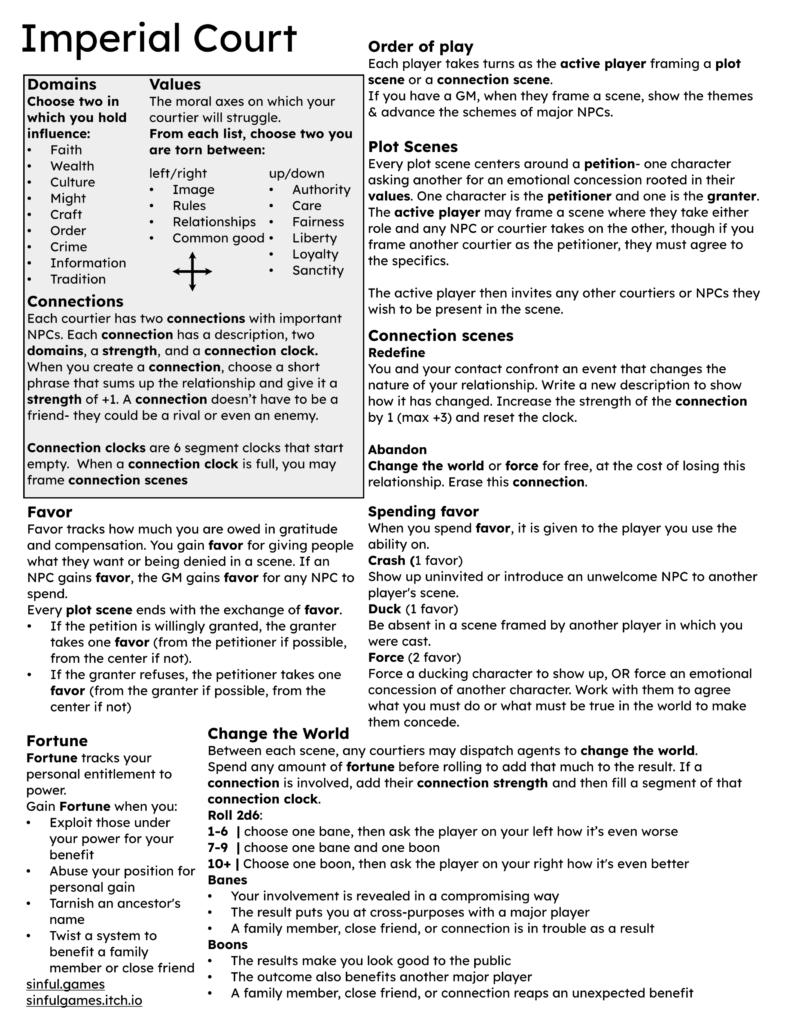
Here it is, in full:
You can find a downloadable pdf of it over on itch
The game uses two resources, Fortune and Favor, to track the power and influence exchanged by courtiers. Each player takes turns framing scenes in which they may pursue their perpendicular objectives and challenge their moral principles.
I plan to expand this game significantly over time, including a setting, tables for generating conflicts and objectives, resources for tracking the state of the world, and refinements based on playtesting.
My goal with the game was to develop player-facing resources that create incentives when you receive them and when you spend them. I’ve talked about incentives in TTRPGs before in the context of horror games, and the same things I said there apply here.
Building a setting for politics
I have most of the setting I want to bundle with this already built; a city state that serves as the capital of a bustling kingdom ruled over by six noble clans.
My primary motivation when building this setting is to make sure to give everyone multiple agendas, multiple weaknesses, multiple levers of power. I want a political system that is unfamiliar to a modern audience but which provides plenty of avenues to explore schemes and plots.
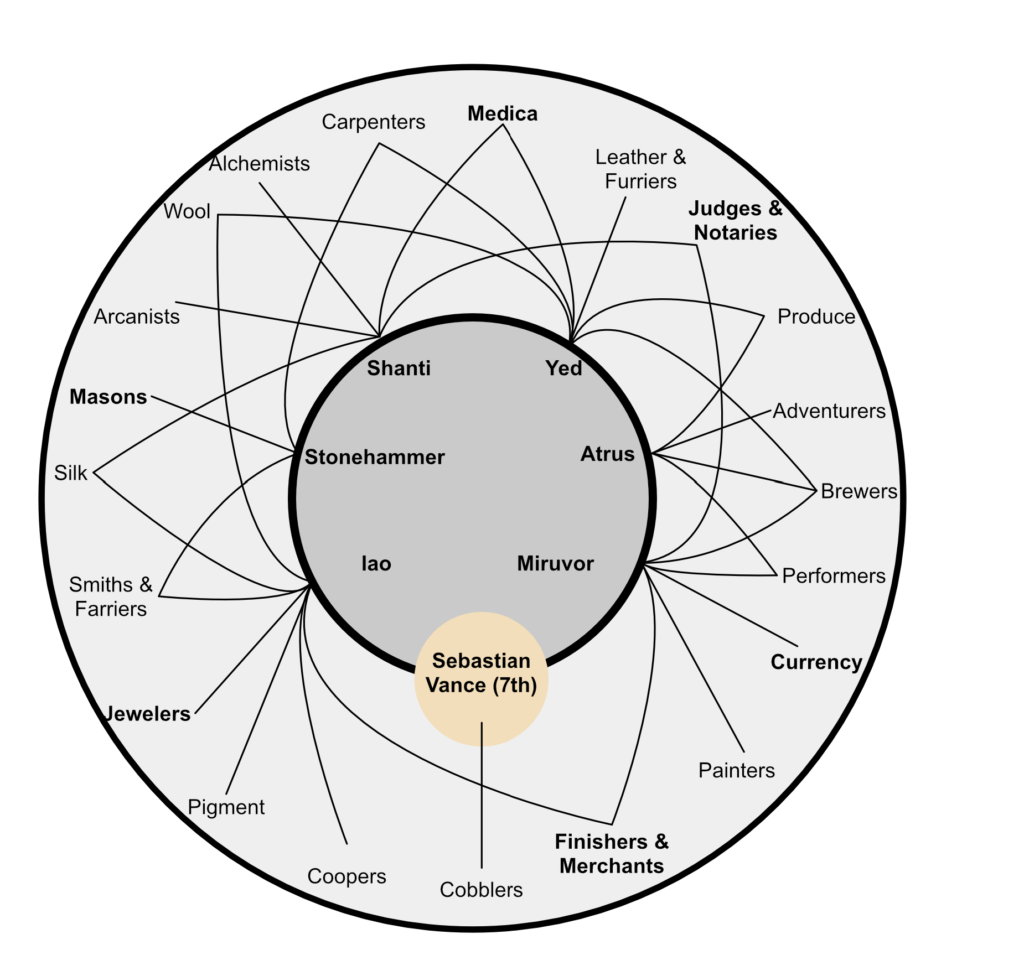
The setting is the city-state of Soothbend. You may choose to play with or without a monarch, but either way, the primary bodies courtiers interact with are the clan council, which controls access to political power, and the guild council, which controls economic power. The clan council votes on legislative and matters and has one seat for each clan, plus one extra seat appointed by the guild council. The guild council has 21 different guilds, who are led by the six guild chairs, who appoint the seventh seat.
The two are entangled in a complex web which I am still trying to figure out how best to visualize. This is the best I’ve got so far:
Make sense? Probably not, but it’s still a work in progress.
Not pictured are the six different churches which were once the family faiths of the six clans, but which have since diffused and blended together and become a polytheistic hodge-podge, or the Oracles, an organization of soothsayers who try their best to remain politically independent, and as a result are an exceptionally valuable political pawn.
So far, it leaves me with at least 35 powerful NPCs each representing a different faction within the setting, and I haven’t even dug into criminal organizations, military figures, and community leaders. Are they all going to be relevant? …almost certainly not. But as I playtest, I plan to fill out the roster and have at least a note or two for each to seed interesting conflicts.
This is just one of many projects I’ve bounced back and forth between as I develop Far Lands in parallel. A lot of these projects are things I’m really proud of, but it’s so hard to share something that feels so incomplete. I’d love to hear what you think of the concepts here!
This month has had some controlled chaos for me. I’ve been kept quite busy with big changes in my day job and technical issues with my laptop, but I’ve made a lot of progress on some important but tedious steps in the layout for Far Lands. But the most important news: on Thursday June 25th and Thursday July 2nd, I will be streaming Far Lands with Open the Gates Gaming on their twitch page.
Open the Gates is a nonprofit organization dedicated to making accessible content and tools for TTRPG players, facilitators, and designers. I was lucky enough to meet them at Pax East this year and they had some amazing input into how I can improve the accessibility of the Far Lands book.
The first session, on the 25th will feature discussion of the game and some of the worldbuilding steps, and the second on the 2nd will feature gameplay. I couldn’t be more excited to share the game with them and with the world!
Accessibility features
It’s thanks to the folks at Open the Gates gaming that I knew what to do once I was done putting all the text of the game onto the book pages. I want everyone who’s interested in bonding with friends on the trail, making discoveries, and witnessing the sublime to play Far Lands, and that includes people who don’t experience the book in the same way I do.
It’s been important to me from the start that the book be both readable front-to-back and usable as a reference manual during games. For a long time I struggled to know how exactly to strike that balance. But it turns out, a lot of the same features that help people with different accessibility needs than myself will also make the book better for everyone.
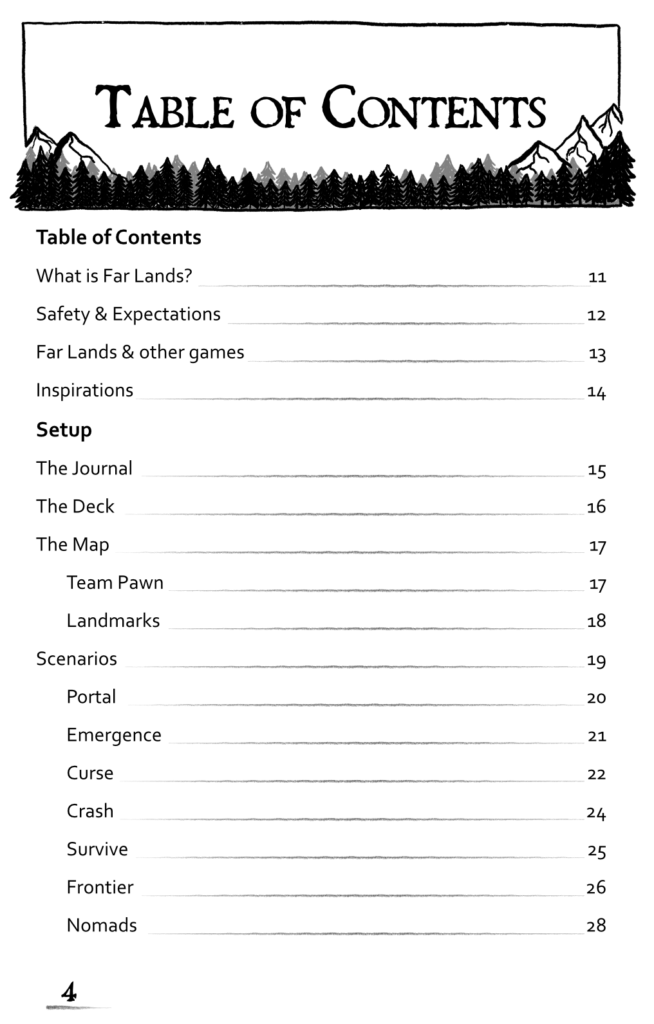
First page of the Table of Contents for Far Lands, showing the introduction, game setup, and a selection of scenarios
Navigation features
As of this month, I now have a table of contents, and index with clickable links. I have a glossary of terms, and clickable page cross-references. It’s not perfect, but it exists, and that’s all that’s needed for this stage.
I’m currently working on adding a mini-table-of-contents to each section that summarizes and provides links to each of the sub-topics of the chapter. I’ve also added mini versions of some tables when they’re referenced in multiple places in the book, so that you don’t have to flip from one place to another as much.
Readable fonts
I’ve downloaded a few fonts designed for readability: Atkinson Hyperlegible and Lexend are my favorites. These fonts were designed through study and experiments of what makes text more or less readable by a diverse range of individuals. And the result is fonts that honestly also just look good to my eyes. While I’m not using these fonts everywhere in the book, having these available will help me make sure the text is as readable as possible.
Alt Text
For next steps, I will go through and add alt text to all of the art and images in the book. When I spoke with the folks from Open the Gates gaming, I learned that alt text for images can be more than just a literal description of what appears in the image- it should ideally serve the same purpose that the image does for a reader / listener. If the purpose of the image is to convey a feeling, the alt text can be written to accomplish the same!
“Bare Bones” / “Ashcan” edition
Finally, taking a cue from MÖRK BORG, I’ll be releasing a version of the book with a significant amount of graphic elements stripped out. While it’s not as strictly necessary as for MÖRK BORG, a game known for its bombastic and overwhelming visual style, it lets me accomplish a few things at once:
A minimalistic, high-contrast version of the game for folks with visual impairments or who use screen readers and don’t want to deal with alt text or funky page formatting
A stripped-down but fully functional version of the game I can use as a freebie for folks who want to try before they buy or can’t afford the full game (and don’t want to take advantage of community copies)
A quick, lightweight reference document with a smaller file size
This will also be a benefit I can provide to backers of an eventual crowdfunding campaign quickly after funding, as it will be easier to put together than the fully-featured version! It will still feature all the navigation features I described above, but the art and graphic design will be dramatically stripped down.
What’s next?
Over the next month, I plan to continue filling in holes as I find them and polishing up the accessibility of the game. I also have a few variations and minor tweaks to the rules to playtest, so expect some exciting updates as these pieces all come together!
Have you ever wanted to be bad? To break the unwritten rules?
The rules of etiquette around TTRPGs are critically important to keeping a game fun for everyone at the table. But at their most strict, they can be limiting for the story potential. The thing that makes the most interesting story isn’t always what’s the most fun at the table, and sometimes you have to compromise- and you should pretty much always choose player experience. But is it possible to have both?
There’s been a lot of talk lately about “safety tools.” What they are, what they’re supposed to do, the pros and cons of various specific tools. (My personal favorite right now is the Palette Grid by Jay Dragon). A lot has been said about them by other folks, but I’m interested in talking about a broader context they exist within: Permission structures.
Today I’m going to dig into what you’re allowed to do in a game. Not just by the rules of the game, but by the other people at the table. When, why, and how do we get permission to do stuff that we usually wouldn’t? Understanding when, why, and how we get permission will also help make anxious or new players more comfortable at the table.
“That Guy” vs the social contract
We’ve all heard the stories of “that guy” at the table. The player who has their own idea of fun and doesn’t care about the fun of anyone else at the table. I’ve been really lucky to only have that kind of experience once, but it was a catastrophe. Any good, experienced player will tell you the phrase “that’s what my character would do” is almost always an excuse to deflect the consequences of being a jerk.
In these cases, the players are acting without permission or without consent. While many of these stories come from personality clashes “above table,” a fair number of them come down to a violation of the social contract of the game.
What is a social contract?
The social contract is the set of rules, spoken or unspoken, that everyone agrees to abide by. A tacit agreement that as long as you follow these rules, so will I. And if you break the social contract, you are no longer protected by it, and will face social consequences.
By and large humans are terrified of social rejection and ostracism, so it’s usually an efficient enforcement mechanism.
When we say “contract,” we are being metaphorical; it’s not a literal contract anyone physically signs. But it is important be explicit about what is and is not acceptable, especially with new players or a new group. This is a defense mechanism developed out of necessity and something I highly, highly recommend.
This is one of the most pervasive sources of permission in games. If we’ve all already agreed that something is allowed, then it’s ok to do, even if normally you would hesitate for fear of social consequences.
Session 0: defining the social contract
One of the major reasons for running a session 0 is to establish the social contract explicitly, rather than relying on implicit assumptions. What are the expectations of player behavior and game content? This contract puts limits on what players can do above table and in game in order to make sure everyone has a good time at the table.
This is what “safety tools” are built to do- to pose questions to everyone at the table that force them to spell out the bounds of the social contract they will be bound by. Because every group redefines the social contract with every game, the things that are acceptable change every game, and so if you don’t perform this step, players can have wildly misaligned expectations, through no fault of their own!
Even with the same group of players, in a game about the tension between desperate criminals trying to survive in a corrupt and broken world, it might be ok to harm an NPC tied to another player’s backstory. But in a more lighthearted game, or a game focused on family, that would be totally unacceptable.
In this example, it’s not just about setting the right tone, though that is a factor. It’s also because different games have different sources of fun.
Social contract side-effects
People-pleasing
One major problem with using the social contract to enforce norms around a game is that the looming threat of social consequences casts an outsized shadow over some players. This can result in some unfortunate side-effects that can be difficult to overcome for both players and game masters.
For example, some players might diminish their own preferences to appease other players out of fear of stepping outside the bounds of the social contract. Or players might assume different unspoken rules. Either of these might lead to one player dominating the spotlight simply because they are less constrained in what they feel they have permission to do. In these cases, it’s important to find ways to give these players the permission they need to act.
This might seem like a challenge limited to particularly anxious players. But in some cases, every player might be overly cautious.
Consensus formation
I’ve had experiences like this time and time again. In a recent game of Doomsong in which I was a player, the GM confronted us with a simple situation: There’s an undead gravedigger standing in the middle of the road. It was our job as characters to deal with this, and we would be derelict in our duties if we didn’t. But we were worn down from an exhausting mission and weren’t confident we could deal with it unscathed. And so we discussed what to do… for what felt like forever. The game ground to a halt and the GM had to step in and push us forward, and in the end we left the road and gave it a wide berth.
In a post-session chat, multiple players independently admitted that their character would have wanted to rush in and deal with it head on. But nobody wanted to be responsible for putting everyone else in danger. None of us wanted to violate the social contract.
We didn’t feel confident enough to take a decisive action without consulting the table, and it hurt everyone’s fun and the pace of the game. We felt like we needed permission we didn’t have. This is because we each independently made assumptions about the social contract that was more restrictive than what made sense for the game. After that session we agreed: we were ok with individual player characters taking risky or reckless actions. We just might not always follow them into danger. We decided we were more interested in exploring the consequences of that in character than making sure the team is always of one mind.
A skilled GM can mitigate problems like this with good spotlight management. One tip I picked up recently is to always throw to a specific player, rather than to the table at large to avoid these moments of collective hesitation. But a well-designed game can go a long way towards giving the players permission without requiring that extra effort from the game master.
Why be bad?
So when do we want to push against the bounds of things we might normally assume are forbidden by the social contract or “anti-fun?”
The simple answer is that sometimes it’s fun to explore that kind of story. If all the players at the table agree, it can be a blast to play a game full of betrayal and interpersonal conflict. In fact, a huge number of indie games are built specifically to explore these themes. Look at Monsterhearts 2, a game that explores the messy drama and angst between teenage monsters. Many of the game’s rules are designed to push the characters pressure-cooker of emotions, and it’s delicious. The ways characters can hurt and manipulate one another is a core part Monsterhearts 2. But they certainly not be acceptable in a heroic party of fantasy adventurers!
But as is the case for any type of social norms, the answer gets more complicated than that.
A note of caution: Bleed
It must be said that many of the things experienced players assume as part of the social contract of being a “good player” are there for a reason. There’s a concept in tabletop games known as “Bleed.” (This is another topic that other folks have written a lot better about than I can right now, and if my laptop was working I would include some links here). Bleed, simply put, is when the emotions a player’s character “bleed” out into the real world, or vice versa.
The things we experience in a game can often feel just as real as the things that happen to us in our lives. So any time you peel back layers of that social contract to explore types of story, the risk of someone actually getting hurt increases. While it may be fun and interesting to tell a story about being betrayed by a friend, actually being betrayed by a friend feels really bad. And if you’re not prepared for that eventuality, it can lead to a bad time at the table for everyone.
This is part of why so many of the games that explore these types of themes come with well-defined safety tools. Systems like the X-card, Lines and Veils, and running a session 0 go a long way to help mitigate these risks.
So what can we do about it?
Permission and Consent
There’s an important distinction between permission and consent. Permission, by and large, comes from a position of authority. Consent comes from an agreement with a peer. For example, I might ask the game master for permission to use an ability in a way that bends the rules. I might ask another player for consent to steal something from their character.
In many cases, if a player has both permission and consent to take an action, it can even go outside the bounds established in session zero- though one should approach such cases with extreme caution!
Consent can only come from one place- the person whom the action affects. If you want to do something that affects another player, you need to have that player’s consent in order for that action to take effect in the fiction. This is true even if it’s been discussed in session zero, or even if it’s been allowed in the past. If I, for example, try to steal something from another player character, it only makes the game more fun if they’re also interested in the outcome of that action. If they’re not, it just makes me a jerk if I try to do it without talking it over first.
Permission, though, is a bit more complex, because there are numerous sources of authority in a TTRPG.
Authority & sources of Permission
The Game Master
The most obvious source of permission in most TTRPGs is fairly obvious- the game master. It’s a common truism in TTRPGs that the game master has the final say in what happens in the game, regardless of what the rules or any other player says.
“The D&D rules help you and the other players have a good time, but the rules aren’t in charge. You’re the DM, and you are in charge of the game.”
– 5e Dungeon Master’s Guide (2014)
But this isn’t a complete answer. Plenty of TTRPGs don’t have a game master or any kind of facilitator at all. And though it’s not obvious, there are other sources of authority in the game that can even supersede the game master.
The Social Contract
The second place we can get permission is something we’ve already discussed- from the social contract established by the group during session zero. For example, if we’ve all previously agreed that we want to allow PvP, as a player you don’t necessarily have to ask the game master for permission! They might push back if it isn’t an appropriate time (and you should still ask the target of your ire if they want to engage in that right now). But you already have permission.
In this way, establishing a clear social contract through your session zero is even more powerful than asking the game master for permission in the moment, because especially timid or unfamiliar players may feel they need permission before they even ask, or that being told “no” will come with social consequences. But if it’s already established that romancing an NPC is ok, someone who’d be embarrassed to ask might feel comfortable to just go for it!
The Game Designer
Finally, we come to the core of what I’ve been thinking about. How does the game designer signal to the players what they are allowed to do in a game?
The simplest answer is: Write a rule for it. In the original edition of Apocalypse World and Monsterhearts 2, sex is explicitly allowed by default through “Sex Moves.” By implementing unique effects for each playbook which trigger when your character has sex, it grants players permission to explore that topic in the game, unless the players agree to re-flavor or ignore those rules (for example, I’ve seen groups that reflavor those moves as “intimacy” moves rather than specifically “sex” moves).
As another example, a rule could have a special case when acting on a player character; for example, in Dungeons and Dragons, there is no rule for persuading another player character, but in Masks: a New Generation, the move “Provoke someone” has a special case for being used on another player:
For PCs: On a 10+, both. On a 7-9, choose one. • if they do it, add a Team to the pool • if they don’t do it, they mark a condition
This gives the players at the table permission to make this move against other players’ characters. Importantly, this move does not actually require consent of the target to initiate. Why? Because the target of the move still has the choice whether to act or not. A success on this role does not force the target’s hand, it gives them an incentive to take that action.
And that brings us to an important part of permission structures in a game. Incentives.
That’s right, this whole post is a sneaky way for me to talk about designing incentives again.
In my recent blog post about incentives in horror TTRPGs, I talked about the different effects different types of incentives can have. Incentives can give a player something or take something from them. And that thing could be good or bad for the character. But no matter the incentive, if it encourages people to act in a particular way, it creates implicit permission to act in that way.
(As an aside, this is part of why not all systems are right for every table. If a player is given permission and incentivized to take some action forbidden by the social contract, it creates friction between the players and the game. At best, it makes the game less fun than it could be, and at worst could cause real conflict and hurt between players.)
For example, to go back to Masks: a New Generation, if a character has marked the condition Angry, they suffer a -2 penalty to the moves “comfort or support” and “pierce the mask.” This character is too angry to consider other people’s emotions or motivations- and the mechanical penalty incentivizes the player to play along. For a player in this situation it might be more polite to help someone who is hurting or try to understand a situation. But because of the penalty to doing so, the player is given permission to act rashly and disregard others’ feelings.
Doubling up on the incentive, however, is the way it is cleared: “To clear Angry, hurt someone or break something important.” This is effectively two incentives: You gain something bad if you act against the condition (a -2 penalty) and you lose something bad if you play along (clear the condition). But it also gives the player permission to hurt someone or break something.
Denying permission
The game designer can also deny players permission. As easily as we allow something we can forbid it. As above, we can strictly deny something: “Player characters cannot attack other player characters” is a very easy rule to imagine putting into a game.
However, as a designer, we have to be careful what we accidentally deny through implication. This is a huge pet peeve of mine, and something I see frequently in older TTRPGs and games from inexperienced designers.
The pitfall is this: If you explicitly allow one character to do something, you implicitly disallow all other characters from doing that thing.
For example, in Advanced Dungeons and Dragons, the Thief class had the ability to pick locks. However, because this ability was given to the Thief, no other character would be able to pick a lock. If the Thief wasn’t given this ability, in theory any charactercould attempt to pick a lock. Without specific rules for picking locks, a game master could grand permission to a player to attempt it making a ruling based on the existing rules. But because this ability is given to the Thief and them alone by the game designer, it would be unfair to the Thief if just anyone could do it!
Likewise, if a game has, for example, an ability that any character can take that grants the ability to drive a car, by implication any character that does not have that ability cannot drive. Without that ability in the game, one could make the assumption based on context whether a given character would know how to drive.
This can be used to positive effect as well- in Blades in the Dark, a character can unlock the ability to punch ghosts. By implication, this means that a character without that ability cannot punch ghosts. (The actual rule is a bit more nuanced than that). It’s a very elegant way to tell a player something that they can’t do: Tell them they can’t do it yet.
But when we give specific characters permission to do something as part of character creation, we also deny all other characters permission to do that thing. So we have to be careful what abilities we make exclusive!
Awkward denouement
Unfortunately, my laptop is in the shop and I’m not going to get it back until next week, so I don’t have a great conclusion written up to put here. BUT! In my next game design post (after the next Far Lands update) I will break down the different types of incentives you can put into a game and the effects they each have.
For now, open up a game you like and take a look at some of the rules. Ask yourself if the rule allows you to do something you wouldn’t assume you could do or forbids you from doing something you would have otherwise assumed you could.
I hit some huge milestones this month and have some amazing stuff to share!
Layout first pass is done!
Every bit of text I had written for the book is now laid out! For the first time, I have an approximate page count at 132 pages. I expect that number to change as I create the index, finalize the appendix, and add in the final art pieces.
As I approached the end, getting through the final section was tough. Even knowing I was approaching the finish line, it was difficult to press on because i had saved the work I was least excited about for last. When I finished the last page, I expected to know right away that I was done, but it was hard to convince myself that I hadn’t forgotten something! I went back through the book and discovered that I was, in fact done.
It feels amazing to have hit such a large milestone so far ahead of what I had anticipated. So now I’m planning out my next steps.
What’s next?
For now, I’m taking a short break. Nothing too long, just enough to refill the well. I’ve been inspired on a board game project and wanted to practice making and playtesting with paper prototypes, a skill which is very relevant for all my game design!
But for Far Lands, there’s still a lot of work to be done.
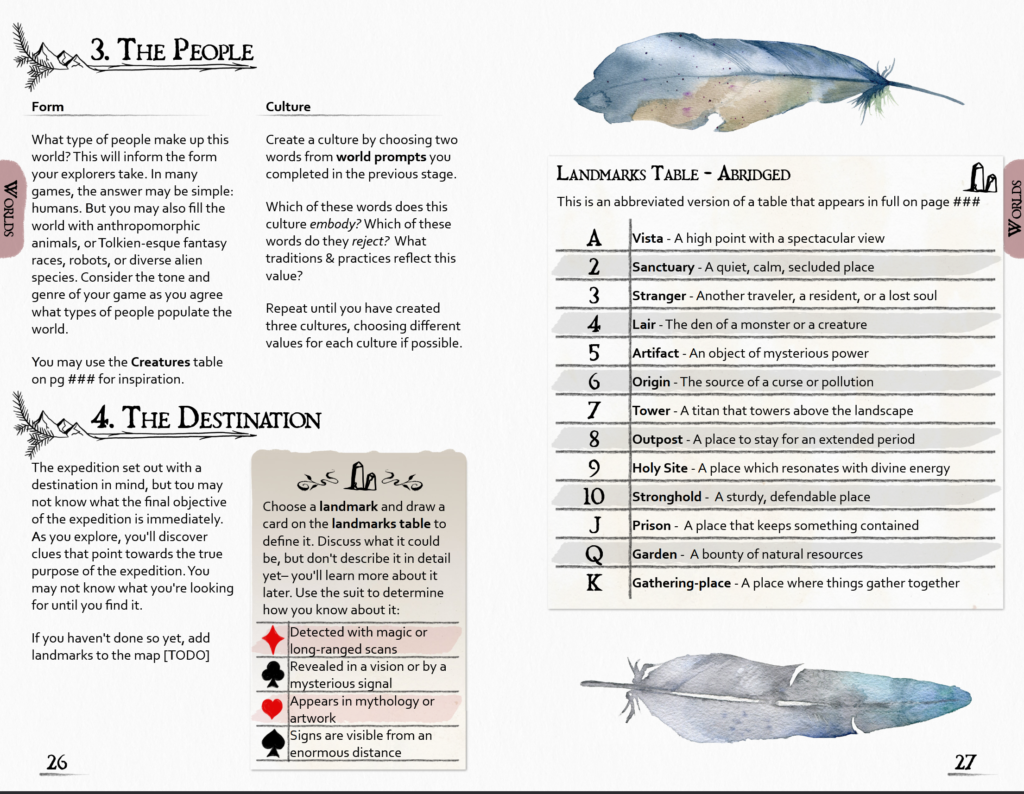
Polish: My first pass was rough in places, and it’s going to need a fair amount of polish. Text and page element alignment, style consistency, spot art, copy editing, and filling in a few blanks I left. You can see a few rough spots here:
Final testing: I am planning on playtesting some variants and tweaks to streamline the rules and terminology slightly. Now that the rules are all laid out visually, it’s easier to see that some of the terms I use are clunky, or ideas that could be explained more concisely.
Sensitivity reading: In the near future, I hope to contract a sensitivity reader to look over a few specific passages as well, as I want to make sure to communicate clearly and compassionately about the real-world history of imperialism, colonialism, and exploitation of indigenous peoples by historical “explorers.”
But in addition to this polish work, I have a few exciting events to talk about!
Upcoming live stream!
In late may, I’m going to be streaming a Far Lands demo with Open the Gates Gaming on their twitch channel. I met them at Pax East late last month at an accessibility office hours event they hosted and they had a lot of amazing advice I am excited to put into practice. Expect more details as the date approaches!
First convention demo
I facilitated a game of Far Lands at Somercon over the weekend! It was my first time running a convention game, and the nerves were intense, but I could not be happier with how it went!
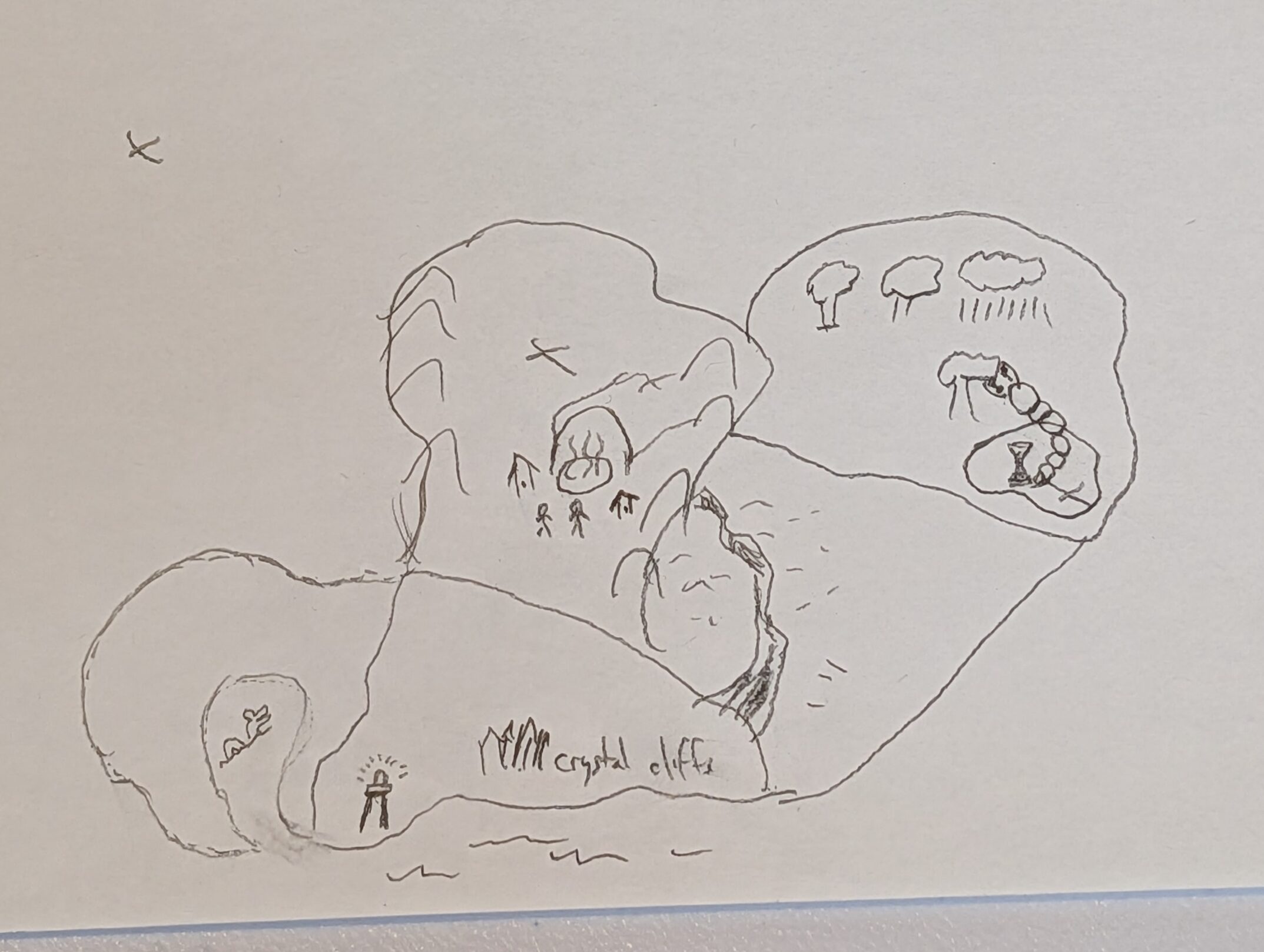
The players created an archipelago of islands caught in a time loop. They scaled the crystalline cliffs of the island they believed to be the source of the loop, were lured into losing time relaxing a hot spring cavern, and finally found and slew the Time Worm that was slowly devouring the world.
During the journey, the chronomancer Solomon used up the last of his time to hold the sands of time still for long enough for the team to reach the mysterious cabin where it all began. The soothsayer Athyar finally understood the lesson that Solomon had been trying to teach him- that there’s more to life than always preparing for the future. The vanguard Brigg finally forgave himself for Solomon’s death in a past iteration of the time loop, an event that Solomon had long since forgiven him for. And Brigg and the automaton he crafted, Tau, finally came to see one another as father and son.
The narrative arcs these players crafted really made me fall in love with Far Lands all over again. My goal has been to make a games that allow people to tell the kind of stories I love, and I think I’ve made something really great.
I did learn a lot about running convention games though! There are a lot of little things to tweak about how I get set up and how I facilitate the game when under a tight time constraint. But I couldn’t be more excited for next time.
There’s an adage in economics that seems obvious, but highlights something that’s critically important to understand in game design: “People respond to incentives.” I’ve been thinking about them a lot lately, and while the examples I use here are largely horror rpgs, the lessons are applicable to just about any tone of game.
I had the opportunity to play Delta Green recently, a game inspired strongly by Call of Cthulhu. It was an amazing experience, thanks to a game master dedicated to creating an immersive experience that responded to our characters. It had just enough real-world details to make it feel like something that could plausibly happen. the tension at the table was palpable at times. However, during the game, I noticed something interesting: we were all playing our characters very cautiously.
After the game, I had a chat with the game master about it, and he said he’d noticed that every time he ran the game. It’s hard to tell stories about characters who push through the fear to investigate further, or who do something that a genre-savvy player might know spells their doom. Part of this is because people get attached to their characters and don’t want to see them suffer- which is understandable, but we all knew what we signed up for.
And yet: we never went into the spooky house, we just burned it down. We never investigated the sounds from below the ground, we just collapsed the entrance. We never learned what was really going on and were happy to get out alive. It was an immensely satisfying play experience… but it was not a good story.
This isn’t a problem that veterans of this type of game have, or of any hyper-lethal old-school RPG, for that matter. But why is that adage of “drive your character like a stolen car” is much easier said than done?
There was a trade-off made in the design of Delta Green: Creating the right feeling at the table and making it easy to tell the right kind of story. And to find out why it works out the way it does, we have to look closer at the incentives the game provides to the players.
What are incentives?
An “incentive” is anything that motivates someone, for good or ill. Something that spurs someone to action. Incentives make you want something (or want to avoid something). There are broadly two types of incentives, described aphoristically by the phrase “carrot and stick.” If you want someone to do something, you can offer to reward them if you do… or punish them if they don’t.
Incentives, importantly, always provide a choice. Unlike a rule which says “you must,” incentives always propose “if you do…” (If you take the gold, you will be cursed. If you betray your friends, you will be paid). They’re more subtle than a hard-and-fast rule, however they can be very powerful yet deceptively easy to overlook when designing a game.
So what were the incentives doing in Delta Green?
Incentives create a feeling
Following in the footsteps of “cosmic horror” games before it, like Call of Cthulhu, each character has a pool of sanity points. Whenever a character encounters something frightening, mind-bending, or supernatural, they may permanently lose some amount of sanity points. And while it’s possible to gain them back one or two at a time, you lose them much faster than you could ever regain them.
This fits the concept that the cosmic horror genre has of sanity- when you know too much of the truth, your grip on reality becomes more and more tenuous, and you can never un-learn what you’ve learned, never un-see what you’ve seen. And if you run out of sanity points, your character is permanently removed from the game. Whether they flee, or die, or just become an NPC under the GM’s control, they are now no longer playable.
The largest effect of sanity points is the feeling it creates in the players. That feeling that something is being lost that can never be regained. And that feeling instills in the players some of the fear and dread that their characters experience. This is a part of what created that atmosphere of tension and dread at the table that made the moments of release when we made it out all the more cathartic.
But if it evoked the right feelings, why didn’t it create the right kind of story?
Feelings create action
It’s simple, when you think about it: The fear of losing our sanity points made us behave more cautiously. As the economist say, we responded to the incentives. Even though it was our characters in danger, not us as players, we feared losing our characters through the proxy of losing sanity points.
It might have been a more interesting narrative if we investigated further, but that wasn’t the pattern of play the game incentivized us to pursue. Doing so would be directly against not just the interests of our characters, but against our own interests. If we did decide to look further and our character witnessed something traumatizing, we as players would be punished with the threat of losing our characters!
But why is this simple thing, ticking down a number on a sheet, so powerful at creating fear in the players at the table?
The Endowment Effect and Loss Aversion
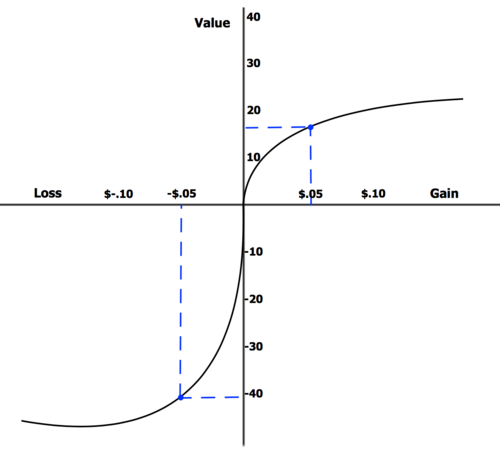
People by and large hate to lose things they have. If you give someone $5 and then take it away, they will feel like they have less than they started with. This is known as the endowment effect (or “divestiture aversion”), and it’s a well-studied phenomenon in psychology. People tend to value more highly things they already have than things they could stand to gain, and so letting go of things hurts more than it should.
Likewise, loss aversion tells us the simple truth that people just hate to lose. It feels worse to lose something that it is to gain it in the first place. Losing two sanity points feels more bad than gaining two sanity points feels good, so the outcome is net negative.
A graph of perceived value of gain and loss vs. strict numerical value of gain and loss. A loss of $0.05 is perceived as having a greater utility loss than the utility increase of a comparable gain. (From Wikipedia)
These psychological effects seem to be very consistent and powerful across numerous studies. This is incredibly useful to us as designers, because it gives us our stick from the “carrot and stick” aphorism.
It’s clear to see now what was going on in Delta Green. Our fear of losing sanity points made us feel some of the fear of our characters. This created the right feeling at the table, but caused us to act in a predictably over-cautious way.
Can you have both?
But is it possible to get both the right feel at the table and the right kind of story? Absolutely! I mentioned previously that experienced players in this genre don’t tend to have this problem. So why is that?
This is largely because experienced players have learned, after much demonstration, that losing your character is the point of this type of game. It’s inevitable. For many, it’s a lot more fun to enjoy the ride down and go out in a blaze of glory. Or, some might learn to lean into the paranoia and revel in outsmarting the horrors without succumbing to them.
But it’s generally true that newer players of any TTRPG are much more likely to become very attached to their characters, and experience a lot of painful bleed when their character suffers. By contrast, more experienced players have often learned to separate themselves from their characters more. They’ve experienced their characters suffering, and know that they, as a player, came out ok. And they tend to be more comfortable taking on an authorial role, looking for the most interesting outcome, which isn’t always success.
And so through focusing on the overall narrative, experienced players can overcome the trade-off and get both a good story and the right feeling at the table. You can feel the fear created by the threat of the stick, but push through it and do the more interesting thing anyway. But is there a way to make it easy for new players to get both?
Let’s see what happens if we invert the incentives.
Carrots (and other little treats)
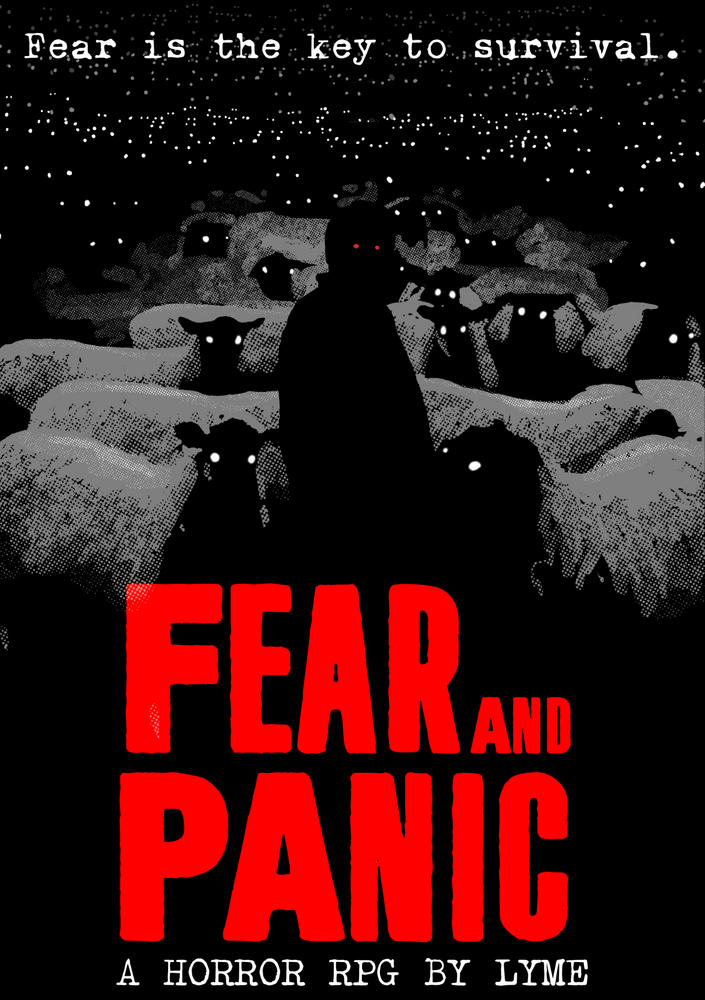
Fear and Panic, by Lyme is the perfect game to contrast with my experience playing Delta Green, because it almost perfectly reverses the incentives created by the sanity points mechanic.
In Fear and Panic, when you see something that challenges your sanity, rather than losing sanity points, you gain fear points. This flips the loss aversion on its head: we’re no longer losing something, we’re gaining something, even though for our characters , the situation is the same.
And unlike in Delta Green, where running out of sanity points causes a massive punishment -losing your character forever- in Fear and Panic, fear can be spent for bonuses to rolls or to activate special actions… but only for actions that demonstrate your fear or instability like fleeing, lashing out violently, obsessing over a task, or having a prophetic vision. But gain too much fear and you might pick up scars that permanently change your character.
“A survivor can go the whole game without ever being scared, but with no fear to spend, they may not survive for long.”
Fear and Panic, p. 14
Suddenly, it’s easy to imagine as a player wanting to go investigate that sound. Being excited to go into a spooky house in the woods. Because we want those fear points to spend; they just seem fun! So our investigators are suddenly curious, risk-taking, and getting a lot more up close and personal with the horrors.
But fear points get us both coming and going: once we have the points, we want to spend them. Because we want to succeed, we want the bonuses, so we’re more likely to act in a way that will let us spend the points. And now our investigators are also erratic, self-destructive, obsessive… all the things we as an audience would want to see from a character who’s seen too much.
Another example:
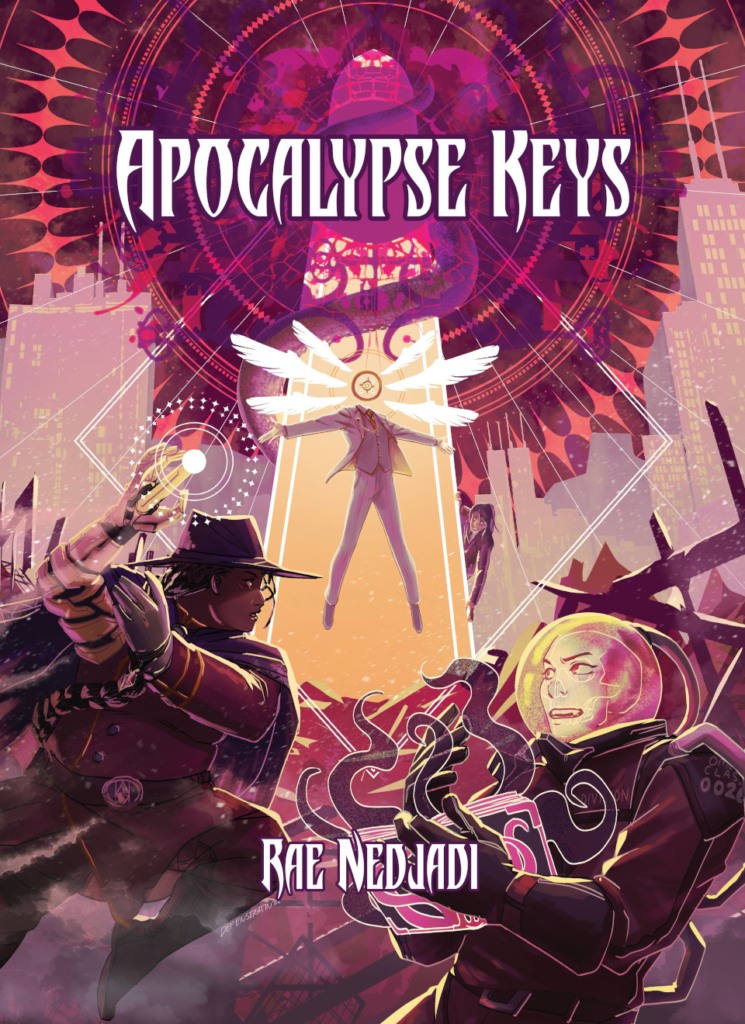
The only other game I’ve seen that use points so effectively like this is Apocalypse Keys by Rae Nedjadi.
In Apocalypse Keys, each character contains a monstrous nature that threatens to overcome them. You as a player can earn points by leaning into your character’s monstrous nature- any number of points you want. And you can spend those points for bonuses to rolls. But spend too many and roll too high, you overshoot your target in a destructive way: a “catastrophic success.” And if you hold onto too many without spending them, you risk losing control to your monstrous side, with disastrous results.
So… can you have both?
It seems like using something like Fear and Panic completely fixes the problem we have- it’s now easy for players to create a story that matches the genre expectations. But there’s a critical difference in the tone of the game. Where players had been afraid to investigate too closely, now they’re excited. This source of easy tension is gone. And depending on the player, that might be ideal. In a lot of horror games, the goal is not to scare the player, but to scare the characters. But some players might want to be scared, to feel that tension, for the same reason a lot of people love horror movies.
Fear and Panic addresses this somewhat by making most high-stakes challenges more difficult. So much so that they’re unlikely to succeed without some fear to spend. That fear of failure is a handy motivator, but it’s less powerful that that ticking clock of sanity. Some other games, like Dread, us other means to build tension. (Like a physical tumbling block tower, in the case of Dread).
But most often, it simply falls to the Game Master. skilled GM can evoke a horrifying tone through skillful narration and writing. Does the ease of pushing players towards their character’s fears rather than away make up for the loss of that feeling of… loss? I don’t know yet. And I’m sure it is different from group to group, but I’m very excited to find out.
So as before, creating the right tone and the right type of story requires a degree of skill and experience… just this time more from the GM than the players. The game has focused its attention towards structuring incentives to create the right type of story, and less towards creating the right feeling in the players. It’s doing more of its work in a different place, so a different part of the game is easier to run.
Where does that leave us?
I am left trying to imagine a game that tries to do both. Would it work as well to build a game where a character loses something meaningful if they don’t go investigate further? Perhaps if you don’t go investigate that noise, you lose more than just an opportunity to find out more. You’re giving in to the way things are. Letting them be. You lose some of your passion. But maybe if you go investigate, you may keep that passion and curiosity, at the risk of physical danger. In this case, we get a game about the fear of complacency, of ennui, of giving up and becoming unimportant to the story.
For now, it’s just a thought exercise. All of the games we’ve discussed today achieve what they set out to do with flying colors by creating the right incentives. We can create tension and drama by threatening consequences. We can get players to take actions they normally wouldn’t by promising a reward. Even acting against what’s best for their own character for a more interesting story.
As designers, one of our great powers is to get people to have fun in ways they wouldn’t think to do on their own. Knowing how to create the right incentives and understanding the incentives your mechanics are creating are the key to shaping the experience of the game and the structure of the story.
Take a look at a any game you have on hand. Pick just about any mechanic and ask yourself: What does this mechanic make me want to do? What does this make seem fun? The answer may often surprise you.
I didn’t make nearly as much progress this month as I did for my previous updates (December, January and February), but that’s because I was occupied with the two things that inspired the game most: Travel and conventions. Specifically, I spent two weeks in New Zealand, and then attended Pax East!
As I write this now, I’m exhausted, but at the same time my mind is buzzing with ideas and motivation. But as I talked about last month, I have to let myself rest, too. This month has been a whirlwind, but it’s done so much to refill my creative well.
So I want to take this chance to talk a bit about the specific trip that inspired Far Lands in the first place.
Olympics National Park, 2021
Five years ago, I went to visit Olympics National Park, to the northwest of Seattle. The park is home to three very intensely varied landscapes: the rugged coastline, featuring beautiful jagged rock formations; one of the only temperate rain forests in the world; and spectacular mountainous alpine forests with meadows of wildflowers.
It was hiking up Hurricane Ridge when the idea first struck me. I was talking with my brother about diceless games.
“In a diceless game,” I remember saying, “The source of randomization for each player is the other players. You never know what they’re going to say. Like in a game of Microscope, you have to adapt to the other players ideas on the fly.”
“But I feel like you need some direction,” my brother said (Paraphrasing significantly- I don’t remember exactly who said what). “If you’re just dropped in without guidance, it can be really hard to come up with good ideas on the spot.”
(you may recognize this idea from my post about white space in game design)
“Yeah, I think that’s what random tables are good for,” I said after some thought. “One of my favorite things in worldbuilding games like Microscope and The Quiet Year is justifying stuff that seems contradictory. It’s what I love about random tables too, especially when you combine multiple elements and explain how they fit together.”
(This idea would eventually become the core of the way regions are created in Far Lands!)
The Distance
As we continued to hike, I mulled over that idea and looked out over this view:
I remember distinctly the feeling I had. I looked down into the valleys and wondered: what’s hidden by those trees? What would it be like to wander through that forest? I realized that, in theory, I could go find out. But the splendor of the view put into me that feeling of the sublime, that combination of awe and terror of the power and beauty of nature.
The snow-capped mountains across the valley seemed so large as to be unreal. They dominated the skyline, their presence a physical weight on my mind, as if their mass exerted its gravity on me across that distance. What would the world look like from their peak, I wondered. What would I see on the other side?
And for a moment I felt as if I was looking in a mirror. If I were to stand on that mountain peak and looked in just the right direction, I would see the very spot I was standing on now.
And as I imagined looking back at myself from that mountaintop, exhausted from the climb, I realized I would feel the same awe and curiosity about the land I was traveling through now. Everything around me would blend together from afar into one landscape, and the same drive I feel to climb that mountain would push me to explore here.
That thought spurred me to look closer at the landscape immediately around me, and what I saw was nothing I had expected.
The Details
This trip happened to coincide with 2021 Western North America heat wave (a horrifying and tragic extreme weather event precipitated by climate change). At the time when we were hiking up hurricane ridge, it was 80 degrees. We were hiking in shorts and t-shirts or even tank tops, and sweating profusely in the heat and sun.
And yet… there was snow on the ground.
The temperature gradient between our heads and our feet was unreal- I could feel the cold in the air up to the level of my shins. One clever hiker scooped up fistfuls of snow in a shirt, tied up the ends, and hung it around his neck to slowly melt and cool him off. It was unlike anything I have ever experienced then or since.
And with the heat wave came an unseasonably early bloom of the wildflowers on the mountain.
And we encountered a black-tailed deer quite closely!
A Discovery… and a challenge
As we hiked through the snow, our feed freezing and our heads sweating, we noticed something that made us worry:
We had heard rumors setting out that one or more mountain lions (cougars) had been spotted in the area. I would learn years later that only a few weeks after our visit, a hiker was attacked and badly injured by a hiker on that very trail. I don’t believe we were ever in any danger, traveling in a group as we were. The threat felt real in that moment, but it was also exciting to know that there was so much more going on in that place that I couldn’t see, revealed only by hints and clues.
The next day
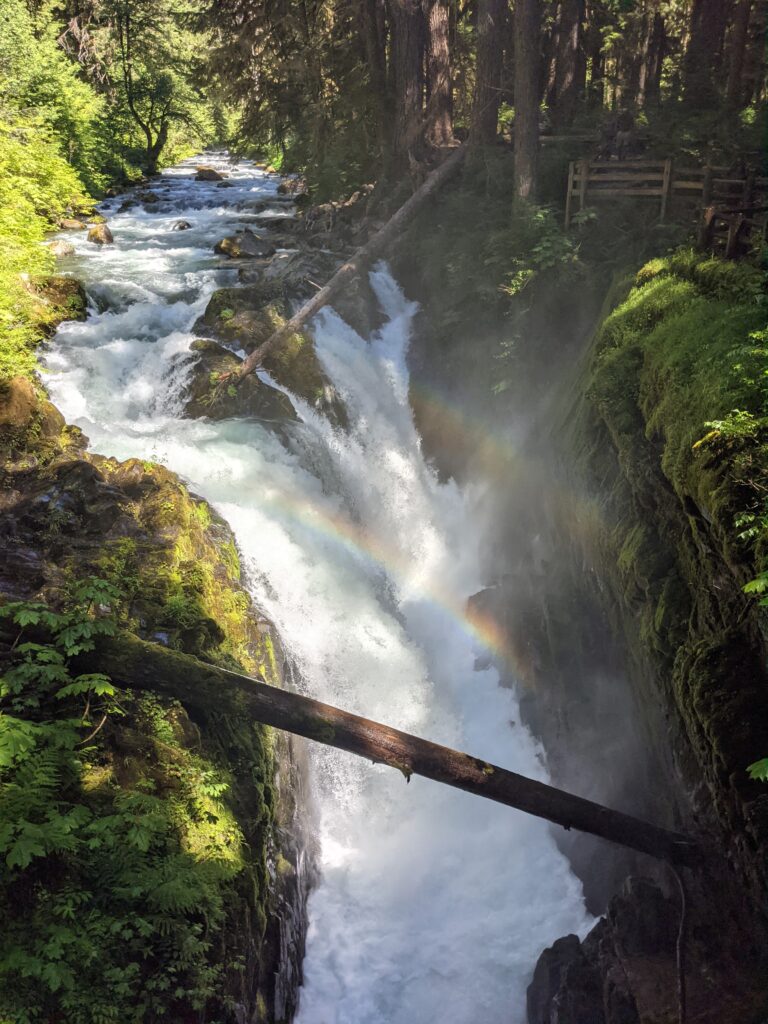
The rest of the trip was just as incredible. I’ll gloss over the details, but the temperate rain forest felt utterly surreal and alien to me, and we encountered countless surprising moments that caused me to re-evaluate the world around me. A stray beam of sunlight illuminating a duckling. A waterfall producing a double-rainbow as it cascades into a crevasse, utterly invisible until you’re right upon it. A row of cairns built on the beach where they would be swept away by the incoming tide.
I came back from this trip with a large part of the game already formed in my head: a GMless game about building a map first by what you see in the distance, and then by what you discover when you actually set foot there. I wanted a game that let you wonder what will I find there, and then go find out. And I wanted a game where you could talk with your companions along the way and learn more about eachother as you discover the world around you. That’s what Far Lands is to me.
And as we approach the five year anniversary of starting to work on this game, it’s nearing completion- at least of the first draft of the layout!