If you missed it, catch the VoD of part one of my Far Lands streams with Open the Gates Gaming here. The video will be available on Twitch for two weeks, after which I’ll post a link to the video on their YouTube page.
Catch us live on twitch next week on Thursday July 2nd at 8:00 PM EDT when we jump into exploring the world we created!
This stream has really reinvigorated my passion for Far Lands, reminding me of what I love and how far it’s come. I’m so proud of what I’ve created and I couldn’t be more excited to continue to share it with the world.
With that said, I’d love to share a bit of something else I’ve been working on.
Parallel development
One of the strategies that has kept up my passion for Far Lands has been letting myself take breaks. I almost never have only one project running in parallel, and when I sit down to work, I will tend to be much more energized if I spend that time working on whatever I’m excited about in that moment.
Of course, it isn’t perfect. It’s lead to periods of stagnation on Far Lands when there was a particularly unpleasant hurdle to get over. But often I find that time away from my main passion project gets me itching to dive back in. And that will get me the momentum I need to get over the hump.
This leads to a lot of unfinished work- but none of them are dead ends. Many of them have bits and pieces I repurpose elsewhere, or will eventually lead to something further down the road. But some of them I’m really proud of, and I want to develop my confidence sharing those things that don’t feel “ready” yet.
Running Politics in TTRPGs
I’ve always wanted to run games with more intrigue. Political scheming, backstabbing, and emotional stakes rather than physical peril. But most mainstream ttrpgs make this exhausting, requiring either the GM does a huge amount of work to set it up from scratch and make it play as intended, or requiring an enormous amount of tracking minutiae.
This is a project that started in parallel with Carpe Omnis games after we talked about this problem at convention one year. We’ve both noodled around with our own versions independently, come together to work on a collaborative version, and then spun off to work on our own parallel versions again a few times now.
Every revision was very much a response to whatever game I was excited about at the moment. Building and rebuilding the systems without ever actually playtesting anything. To this day, I still haven’t actually played any variation of this game!
The latest version is based off of Hillfolk, by Robin D. Laws.
The Prototype
Here it is, in full:
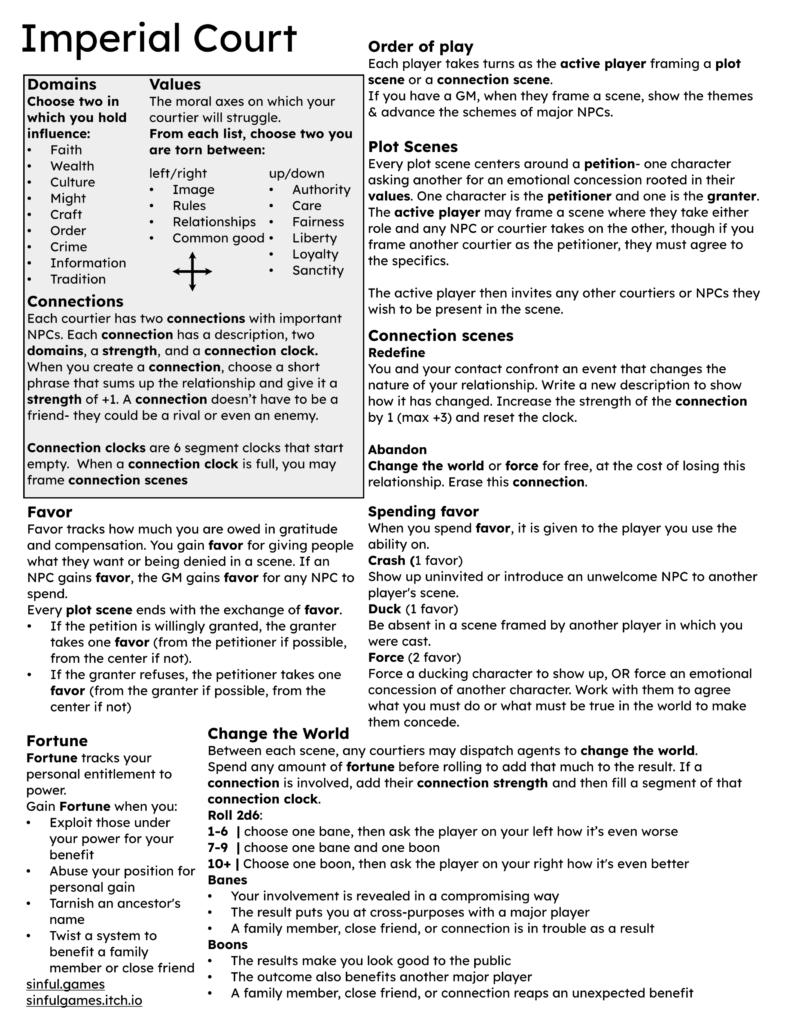
You can find a downloadable pdf of it over on itch
The game uses two resources, Fortune and Favor, to track the power and influence exchanged by courtiers. Each player takes turns framing scenes in which they may pursue their perpendicular objectives and challenge their moral principles.
I plan to expand this game significantly over time, including a setting, tables for generating conflicts and objectives, resources for tracking the state of the world, and refinements based on playtesting.
My goal with the game was to develop player-facing resources that create incentives when you receive them and when you spend them. I’ve talked about incentives in TTRPGs before in the context of horror games, and the same things I said there apply here.
Building a setting for politics
I have most of the setting I want to bundle with this already built; a city state that serves as the capital of a bustling kingdom ruled over by six noble clans.
My primary motivation when building this setting is to make sure to give everyone multiple agendas, multiple weaknesses, multiple levers of power. I want a political system that is unfamiliar to a modern audience but which provides plenty of avenues to explore schemes and plots.
The setting is the city-state of Soothbend. You may choose to play with or without a monarch, but either way, the primary bodies courtiers interact with are the clan council, which controls access to political power, and the guild council, which controls economic power. The clan council votes on legislative and matters and has one seat for each clan, plus one extra seat appointed by the guild council. The guild council has 21 different guilds, who are led by the six guild chairs, who appoint the seventh seat.
The two are entangled in a complex web which I am still trying to figure out how best to visualize. This is the best I’ve got so far:
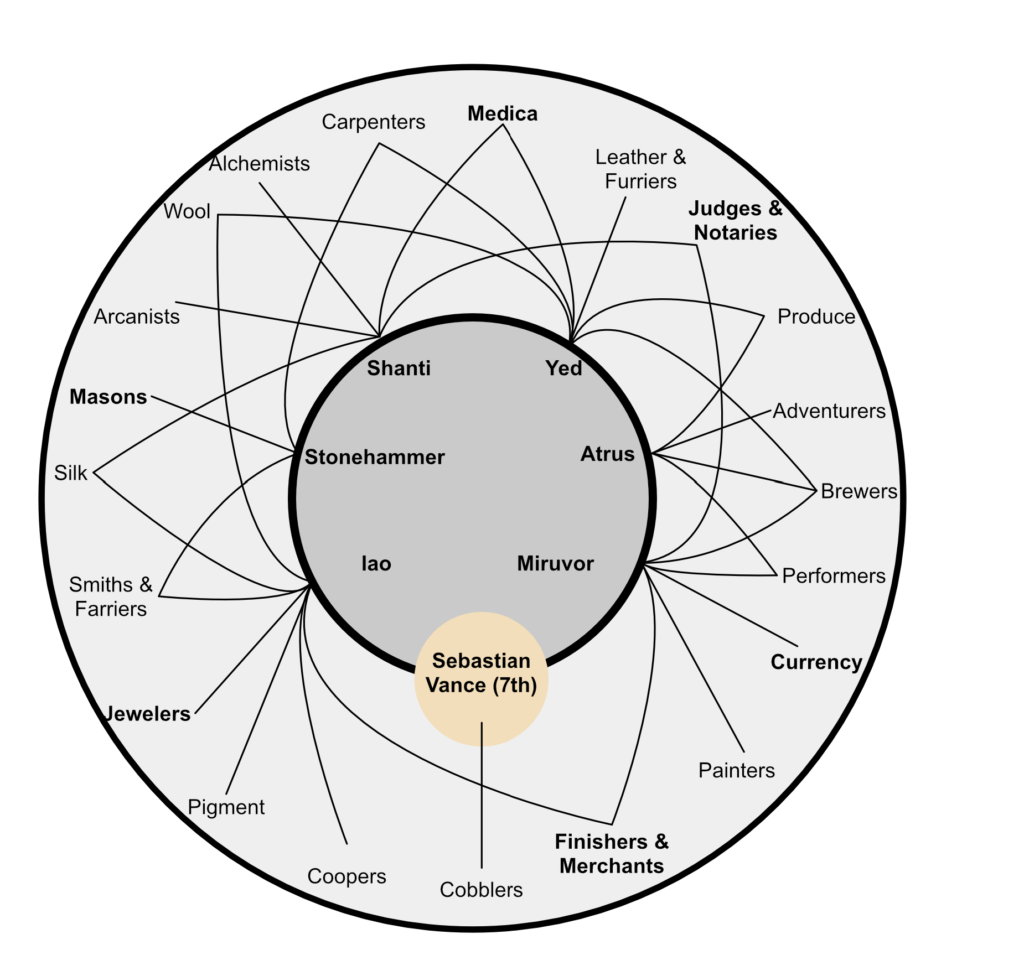
Make sense? Probably not, but it’s still a work in progress.
Not pictured are the six different churches which were once the family faiths of the six clans, but which have since diffused and blended together and become a polytheistic hodge-podge, or the Oracles, an organization of soothsayers who try their best to remain politically independent, and as a result are an exceptionally valuable political pawn.
So far, it leaves me with at least 35 powerful NPCs each representing a different faction within the setting, and I haven’t even dug into criminal organizations, military figures, and community leaders. Are they all going to be relevant? …almost certainly not. But as I playtest, I plan to fill out the roster and have at least a note or two for each to seed interesting conflicts.
This is just one of many projects I’ve bounced back and forth between as I develop Far Lands in parallel. A lot of these projects are things I’m really proud of, but it’s so hard to share something that feels so incomplete. I’d love to hear what you think of the concepts here!