This month has been relatively slow for Far Lands progress, as my passion has been pulled a lot of different directions by side projects, but I have made one major step I’ve been planning for a while: I’ve reached out to a cultural consultant.
This is something I’ve intended from the very beginning, but I’ve been nervous to take that leap. I am very aware of the troubled history of “exploration” in the real world and in games, and I know it’s had an invisible influence on my work. I’m not trying to make my game universally palatable- rather, I want to discover how this history has affected me and my work, and work to avoid perpetuating the harmful cultural narratives.
I still have a lot to learn, but this post is dedicated to what I have I learned so far.
Terra Nullius
One of the earliest decisions I made in Far Lands was that I didn’t want it to have a large component of interacting with native peoples- the real world history of exploration made that very fraught, and it is imperialist in the extreme to imagine an “uncharted land” that already has people living there!
However, this introduces an opposite problem: “Terra nullius” is a phrase that describes the false image that a colonized land was totally uninhabited before settlers arrived. By forbidding the possibility of encountering native peoples, I risk reinforcing that myth that erases the atrocities commuted by real-world colonizing forces. in the real world, people already lived almost everywhere long before ships were crossing oceans.
Explore, Exploit, Expand, Exterminate
There is a genre of game known colloquially as the “4X” game. The four X’s stand for the heading of this section – Explore, exploit, expand, exterminate.
Nearly every “exploration” game is really about finding resources to exploit, land to claim and settle (expand into), and enemies to exterminate. It’s not hard to see the fraught history that this glorifies! The latter three are almost always the core motivation for the first, and it is difficult to shift away from that motivation as there is so much cultural tradition built up around this type of narrative.
Instead, I have tried to design Far Lands focus on creating interesting questions and exploring to find the answer, pursuing curiosity rather than personal or imperial gain. But it is hard to unlearn those colonial narratives, and I worry those themes have infiltrated the example scenarios I provide.
The Map is not the Territory
This is a subtle one that I was completely unaware of until I read Playing Oppression, by by Mary Flanagan and Mikael Jakobsson.
Reducing a region to a map with fixed borders and names has long been a tool of imperial colonialism. Historically, explorers and imperial powers have used cartography to assigned names to things that already had names, to draw borders around things, to stake a claim to land on paper that they had no tangible claim to. Being the first to discover something (or claiming to be first) comes with a sense of ownership- figuratively or literally planting a flag. Expanding the bounds of the known world comes hand-in-hand with expanding the borders of empire.
To that end, I tried to design the game to always leave more unexplored than you can pin down concretely. There is always blank space left on the map, always things you can see in the distance that you can never physically enter. The map is never “done.” And I never ask the players to name anything. Of course, you can name regions if you want, because it can be fun and harmless, but naming the thing is not really what the game is about.
Faith and the sacred journey
I have noticed over the course of designing the game that the roles I offer to players to build their explorers are powerfully influenced by my own background. In particular, being raised in a very mono-cultural New England town has limited my imagination when it comes to representations of faith.
When I added the Pilgrim role, I looked back at it and was very dissatisfied with it, because the initial draft felt so tied up in my own background. It didn’t feel like it could be used to represent versions of faith very different from what I saw growing up. There was a push and pull as I revised it, along with the Seer, Lore-Keeper, and Evoker roles. I wanted to make them broad enough to represent a wide variety of histories, faiths, and magic practices, but still have enough flavor and specificity to spark ideas.
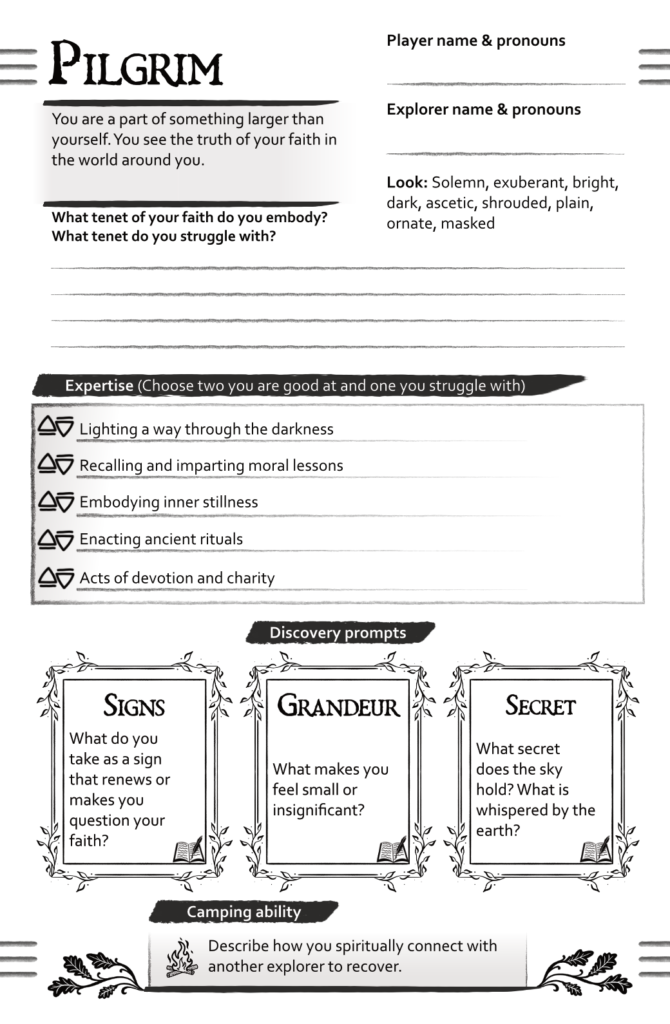
When I had the chance to speak with the folks at Open the Gates Gaming, though, we realized I’d already done something really powerful. Because each explorer is made up of two role sheets, a very wide range of faiths is represented by virtue of the other role sheet a character has. Is a character a Pilgrim / Crafter? Then perhaps the faith has a focus on craft. A pilgrim / seer may have a very spiritual faith, where a pilgrim / mentor may be focused on forging connections with others.
I know there’s more I can do, and more I can learn. I was nervous diving into this part of the journey because I was afraid of being wrong. I was afraid that I had been doing the wrong thing for a long time and hurting people without realizing. I was afraid that it would be difficult to unlearn these narratives that have been so ingrained in us from birth.
But what it has revealed to me is profoundly exiting. Being able to question the default path has let me find a lot of exciting new directions to explore that I wouldn’t have considered. I also don’t want to just blindly do the thing that so many other games an stories do because I want to make something new. And by making a game with sensitivity to the historical harms that come with this genre, I can welcome into it folks who would otherwise have been excluded.
Learning to question assumptions that I had previously taken for granted has allowed me to explore what happens if I change those assumptions, and it’s unlocked design spaces that I hadn’t previously seen. And I couldn’t be more excited to see what lies down those paths.