This is part 2 of my series about making mechanics easier for players to engage with. For the previous part, check out part 1: Cognitive Load
A few years ago, I sat down with to run Masks: A New Generation with a new group for the first time. After introducing the players to the basic mechanics and making characters, we got started. As things kept rolling along, the hero team confronted a giant robot terrorizing a city park, and I noticed one of the players, a veteran of Dungeons and Dragons, had barely spoken up in the fight. Shifting the spotlight, I asked them directly what they wanted to do to try to stop the robot. They looked at their sheet, at the list of, moves, and back at me, and said:
“I don’t know. What can I do?”
This is a difficult spot as both a GM and a player. If you have ever asked your players “what do you do next?” only to get blank stares, you know how this feels. “Anything you want,” is not a helpful answer. In a Dungeons and Dragons style of game, players might have an explicit list of skills and abilities.
But in a Powered by the Apocalypse game like Masks, your choices are left totally open. Instead, the moves are written to trigger based on the narrative situation within the game. You can’t simply choose from a list, you have to invent a course of action, and then see what move, if any, is most relevant. And to a player used to a more constrained set of options, this wide-open decision space was paralyzing!
I’ve grown a lot as a game master since then, and in hindsight, I could have done a better job presenting courses of action (the robot is about to stomp on an ice-cream truck! A building nearby is in danger of collapsing!) But this experience is what lead me to recognize a critical difference in design philosophy that has shaped how I design and run games ever since.
What is white space?
This space was left blank on purpose
White space in design is, quite simply, where there is nothing written. Not just blank space on the page (though this may be the case), but also where there are gaps in the rules or setting. You can see this most clearly in any well-written setting book or adventure module. If the designer knows what they’re doing, they’ll intentionally leave gaps for the players (the GM is also a player) to make it their own at the table.
But in designing rules and systems, it can be a bit harder to notice.
Out-of-scope whitespace
There are a few places you can spot white space in a design. The most obvious is around the edges, outside the scope of what the game is about. Because a game or an adventure is finite, there will always be things left out. Deciding what to leave unwritten can be easy: You don’t need sailing rules in a game set in a desert. You don’t need to explain what’s on a continent across the sea in a module set in a single city.
Sometimes, though, a designer will leave a gap in the design that is surrounded by content. A space where something should be, but there is nothing. And those decisions can be much more difficult, and much harder to use effectively.
So why do we do it? And why is it so important?
Why leave it blank on purpose?
We hammer wood for a house, but it is the inner space that makes it livable
Tao Te Ching, translated by Stephen Mitchell, chapter 11
The high-minded philosophical reason
When designing a game, it’s easy to take on the view that the rules are the game. That the players at the table will execute on the rules, and in so doing, experience the game as intended. But there’s something fundamental missing from that perspective.
I mentioned previously that white space lets players tune a setting or a game to their individual group and preferences. But that’s something of an understatement: White space is what is unique about tabletop role-playing games. Without it, you have not created a tabletop role-playing game; You’ve created a board game. It may have random elements, or choices to make, but every option would be proscribed.
Rules in TTRPGs are different from rules in a board game. Rules are generally clear and rigid, but TTRPGs are flexible and open to interpretation by design. It’s not the rules that are the game, it’s what happens in-between the rules. It’s the conversation.
The rules in a TTRPG are not a merely set of steps to execute, they are sturdy skeleton that supports the wobbly organic bits in-between. They are a vessel that shapes and contains the fluid conversation that pours out of the players.
The blank space you leave within your game is what defines the shape of the game. The part of the game that is not written in the book is the part that is played. And discovering what fills that empty space is a large part of why we play.
Your job as a designer is to structure the conversation so that engaging with it will create the experience that you’re inspired to share
Nathan D. Paoletta, RPG Design Zine
Example: Character sheets
For a concrete example, think of the spaces that are blank on a character sheet:
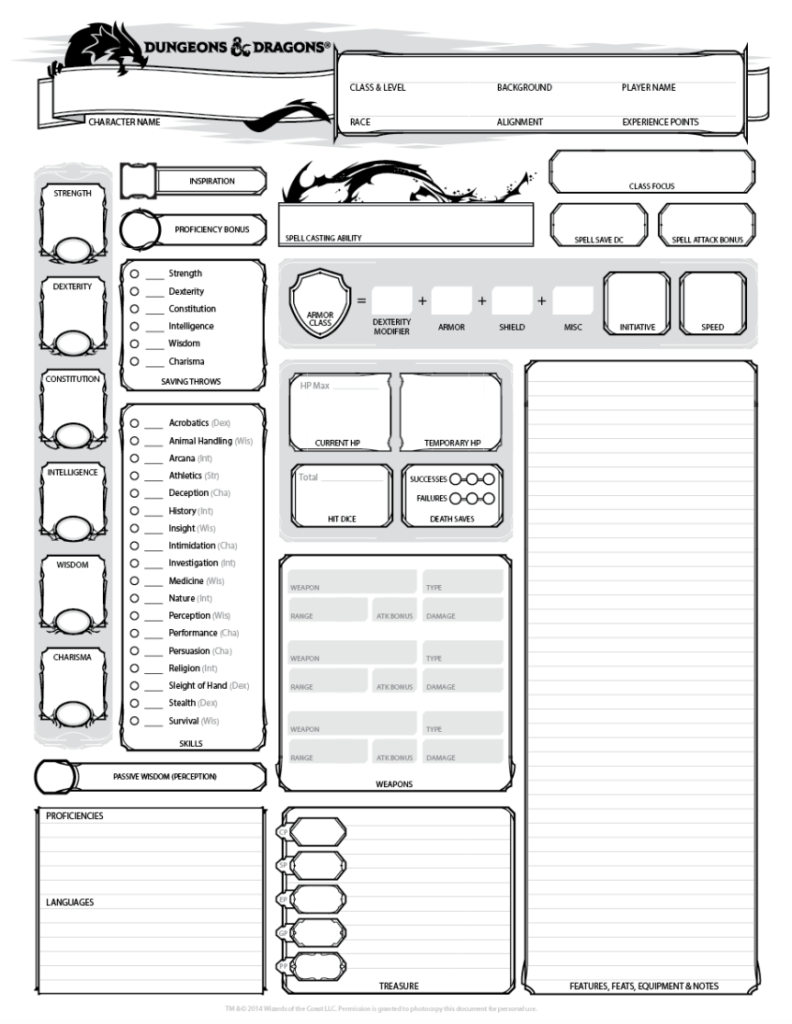
The name, stats, abilities, these are all degrees of freedom in the design of a character because they are left blank on the sheet. But even there, there are rules for how those are to be filled in. But look closer on many sheets and you will see something that doesn’t have rules associated with it: a box with lines for notes, character details, backstory, personality, and so on. Things that go beyond and between the rules to explain why and how this character is the way they are.
Even on sheets that don’t have this feature, (Powered by the Apocalypse games are frequently guilty of this), I’ll see players adding notes into margins, the back of the sheet, or even a separate page that explain the details of their character that aren’t enforced or even supported by any game system.
This blank space is what lets a player feel they own and inhabit a character. Even games have characters already defined for you, like Yazeeba’s Bed and Breakfast, have blank space to fill in as you explore the characters through play.
The Practical Reasons
Well-crafted white space is in ttrpg design has very practical benefits:
White space allows for customization. While choosing from a list is quick and easy, there’s nothing that provides more freedom in a design than allowing a player to make up whatever they want (within reason & the bounds of the game) to fill a space. Like with character sheets and settings as described above, when something is left unwritten by the designer, it falls to the players to write it. And the players at the table can often (but not always) come up with an answer that is better for their specific table than a designer trying to make an answer that works for every table could.
White space gets buy-in. When you’ve had the chance to create part of a character, the world, or part of the game system, you naturally feel a sense of ownership over it. You’re intimately familiar with that part of the game because you had a hand in creating it. You feel authority to make decisions about that part of the game. You feel invested in seeing what happens to it next. This is why collaborative worldbuilding at the start of an RPG is so powerful, but it can work the same magic in so many other places.
White space gets you thinking. There’s something compelling about the space on the map that just says “here there be monsters.” The thrill of curiosity and discovery is a huge part of what drives people to play TTRPGs. Just like I mentioned about customization above, the blank space naturally prompts players to imagine what could fill that space. What could possibly explain everything surrounding that gap? To use Blades in the Dark as an example, Lord Scurlock is presented as a mysterious, seemingly-immortal figure whose personal influence is so powerful that he is on an even playing field with some of the most powerful factions in the city. But exactly what he is or what he wants is left totally ambiguous. As a result, the players almost always want to find out, and the GM gets to have fun crafting his sinister plot. As a result, everyone at the table is engaged.
Putting it all together
There’s a rule in horror that the moment you show a monster to the audience, it instantly loses its emotional power over them. When you can’t see it, you’re forced to imagine what it could be. And what each individual imagines is going to be more powerful than anything a writer could come up with or an artist could create.
As long as the space is left blank, the audience/player is compelled to engage, to imagine what could be there. Everyone has their own monster, and the monster can be different every time. That’s the magic of white space.
The Catch
Unfortunately, there’s a big problem with white space. It turns out, can sometimes be really hard to think of an idea on the spot that’s as cool and interesting as you’d like. Sometimes, it feels like breathing. There’s an obvious answer, or, even better, one that violates expectations in an exciting way. But sometimes it feels like being thrust into the spotlight on stage without knowing any of the lines. Like sitting down for test without studying.
Experience helps, but the experience is still highly variable even for the most skilled improvisers. So why is it sometimes so stressful, but sometimes it feels so natural?
Planting seeds: How make white space green
The secret to making white space work is planting seeds. Prompting players so that by the time they’re asked a question, they already have ideas for the answer. Immersing them in the vibes of the game. Showing them the shape of the gap in the puzzle so they know how to craft the missing piece.
This is green space. Rather than a barren field, the blank space is crafted into fertile soil for ideas to grow. What might look like an empty field actually has seeds of ideas already planted under the surface.
Example: For the Queen
The best example of this I’ve ever seen is For the Queen, by Alex Roberts. For the Queen takes the form of a set of cards, each of which has a simple prompt. It begins with the players being told “The queen has chosen you for this mission because she knows you love her.” Players take turns going around the table drawing a card and answering the prompt on it. At the end of the game, everyone responds to the prompt: “The queen is under attack. Do you defend her?”
I was deeply skeptical of this game when I first heard that premise. Surely, I thought, if the cards are the same, even in a different order, the game would play out largely the same way every time! But I could not have been more wrong. Even though the seeds planted by the designer are the same every time the players sit down to play, they will grow differently every game.
I had overlooked an important part of the game. I hadn’t noticed what was missing: For the Queen has zero character creation. The characters are completely blank at the start of the game. Even the eponymous Queen, though you may have a piece of art to inspire you, is a totally blank slate. As I said in a earlier, the part of the game that is unwritten is what part that is played. The characters are left blank, so the game is about discovering who they characters are.
But how does this work? How could you create a character from a completely blank slate with no rules to guide you? When designing the prompts, Alex Roberts had the mantra: “Tell them something they don’t know, then ask them a question about it.” That simple mantra is an incredibly powerful tool for game design, and it’s the secret to making white space into green space.
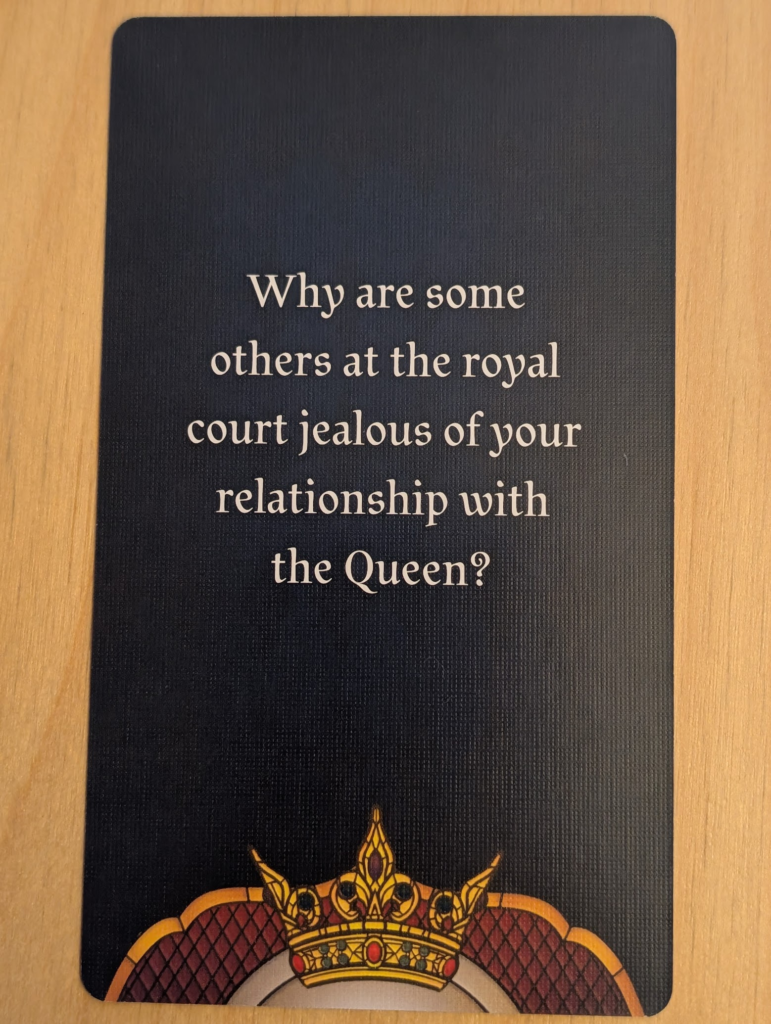
For example, the prompt on this card might look totally open-ended at first, but it actually tells you a great deal: You have a special relationship with the queen, it is known to others, and those others are envious of that relationship, so it must be worthy of envy. But it doesn’t tell you anything about what that relationship is.
The card above brilliantly hides the prompt within a question. It buries the seed, making the hand of the designer invisible while constraining the space of answers to the question. The player no longer has to decide if the relationship is good or bad, or if it’s secret or public. The prompt feels completely open. But when the player starts to answer that question, their answer will naturally fall within the constraints created by the premise of the question. The result will feel as though it is completely their idea.
And yet the player is never alone in crafting their answer to the prompt. They’re guided by the prompt, by the previous answers they’ve given, and by the very premise of the game (the Queen chose you because she knows you love her, after all).
Consider the alternative cases:
- What is your relationship with the queen?
- Some others at the royal court are jealous of your relationship with the queen.
In the first case, the question feels absolutely impossible to answer, especially if it’s the first card you draw! It’s so wide open, there’s nothing to latch on to. There’s no seed crystal to grow your idea off of.
But in the second case, a player would likely feel they’re being dictated to. This is the way it is- no room for debate! Simply accept the premise and move on.
But when both are put together, the magic happens.
The takeaway: Ask leading questions
The secret is leading questions. I was first introduced to the power of this idea at a seminar at GenCon, and it’s totally changed the way I GM. Whenever you have the chance to ask an open-ended question, you can gently constrain the answers to prompt the other players with ideas for how to answer. If you practice this skill, it will make your a better designer and a better game master.
This instantly fixes the “what do you do next?” problem. To steal an example from that GenCon seminar, instead of asking “what do you do next” until the plot advances, decide on something that would advance the plot, and ask the players a question about that.
Instead of “what do you do before the party,” ask “How long do you wait before arriving at the party? How do you get there?” Is this railroading? No. Because players love to be contrarian, and just as easily as it might prompt the players to answer the question you asked, it might prompt them to say “what if we don’t show up at all?” But that answer still moves the narrative forward.
In the Masks example I gave right at the start, I might have said: “The robot is barreling out of control towards a group of civilians. What do you do to stop it?” The player might choose to prioritize something else, but by doing so they are making a major decision about the direction of the narrative.
No matter the situation, tell them something they don’t know, then ask them a question about it.
Expert mode: Begging the question
A leading question doesn’t necessarily have to be a literal question. In fact, the most challenging but rewarding way to make this happen is to get the players to ask the question themselves. To make this work, you have to beg the question.
To make this work, you need two things:
Craft a compelling hook. Present the players with something so compelling and mysterious that they simply must engage with it. Enough details that they can easily imagine what might go there. This is the seed that the players’ ideas will grow from
Then, resist the urge to explain. It’s so challenging as a designer to leave those spaces blank because we get pulled by our curiosity to fill it in just as strongly as the players, if not more. But you need to leave enough blank space to fit a wide variety of options.
For example, in Wanderhome, by Jay Dragon, one of the items the Ragamuffin could start with is “The Heavenblade, lost after slaying the Slobbering God, that you would never use to hurt another soul.” This immediately prompts questions: What is the Heavenblade? What was the Slobbering God? How did you of all people end up with it?
If you fill your game with interesting hooks, but leave them unexplained, like the horror movie monster, players will be compelled to imagine what fills that space. And whatever they come up with will be better for them in that moment than anything you could write.
This is how you plant seeds. This is what makes your white space into green space.