Tag: game design

  • Far Lands update: Filling the gaps and learning to rest

    Last month, I wrote about how I had completed more than half of the work that I expected me to take all year. As of today, I’ve I’m almost completely done with my initial layout pass! All that’s left is the long-form sample of play and the appendix. But there’s still a lot left to be done after this initial pass! Alignment, consistency, copy-editing, and accessibility are all extremely important.

    This post is going to be shorter because it’s a short month, and also because I’m going getting ready for some travel. But I still want to share some of what I’ve learned this month in work on Far Lands
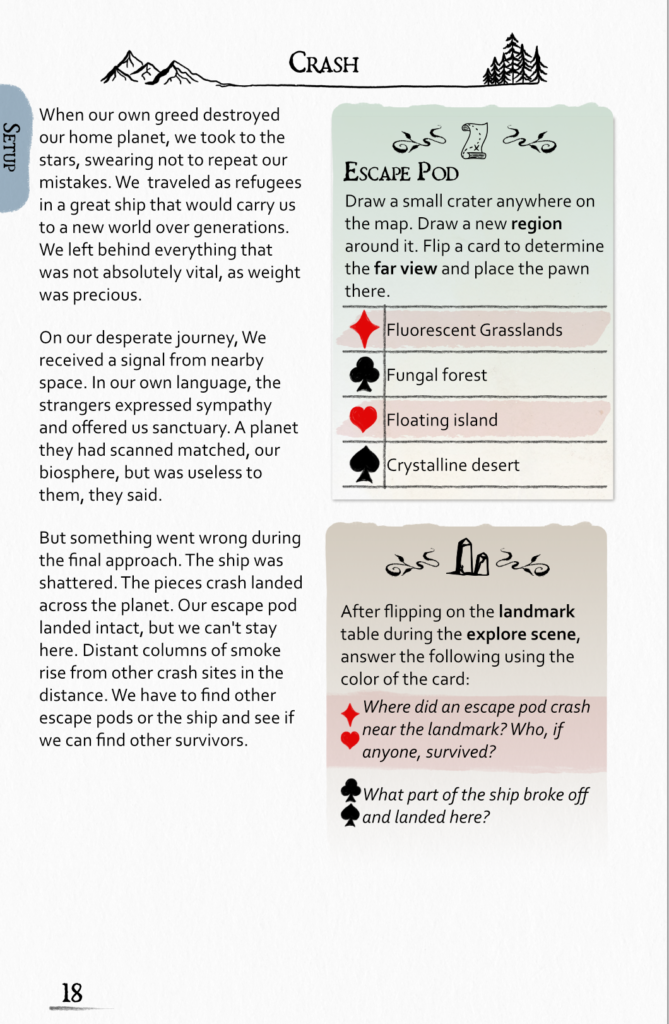
    "Crash" scenario, detailing
    One of the quick-start scenarios

    What I missed

    Doing layout for Far Lands has forced me to reckon with every single word I wrote, and it’s been revelatory. I have noticed a lot of gaps in the manuscript I had totally missed. Tables with empty slots, TODOs I’d forgotten, paragraphs that I’d intended to re-write. I am very grateful that this process has forced me to look over every single part of the game. If I had passed it off to someone else at this point, those gaps could have presented a real problem!

    I talked last month about using white space in your game design, but this space was not intentionally left blank. Oops! But it’s been exciting to re-engage with the game design part of the process

    Leaving the best (worst) for last

    When I started, I laid out my plan for the year, putting things in an order that I felt made sense to me. That order changed a bit as I went, but I realized at some point that I had put them in order of my confidence.This helped in some ways… and hindered me in others.

    The first sections I laid out I was very confident in the text, the rules, and had a clear vision of the layout. This really helped me build my familiarity with the tools. I was able to implement my vision without worrying about having to edit the text too much. By the time I got to the more challenging sections, I already familiar with the tools and the style of the book. As a result, the work shifted from figuring out a visual identity to figuring out how to organize a challenging text.

    But it’s also meant that as I go, I’m feeling more tentative about the text. I knew the narrative journal entries were going to have to be edited for length to fit on a page. I knew some of the scenarios needed content filled in. I knew some of the tables were going to be challenging to make readable. And so the work got harder to engage with. So I needed to give myself a bit more grace. Which brings me to my next point:

    Don’t push too hard

    I talked in my previous far lands update about weaponizing my perfectionism to make steady, incremental progress. I mentioned that I was worried I would push myself to burnout. I’ve been continuing to approach this system cautiously, and as expected, I started running into the limits. Some days, I just end up fully booked with things that are very important to me. Trying to push through to get just a little bit done will keep me up too late or pull me away from stuff I will really miss if I have to decline. And on those days, knowing that I haven’t gotten it done weighs on me all day. It prevents me from fully enjoying stuff I know I could otherwise enjoy more!

    And what I realized is it’s not hard to see those days coming- from looking at my calendar, it’s not hard to know what days I’m going to struggle to fit it in time-wise. So I can designate a day when the reminder doesn’t pop up and know that’s a “rest day.” Or more realistically, otherwise occupied. Because it’s not really a rest day. And that’s kind of a problem…

    Gas, Steam, and Battery

    There’s a theory that I’ve seen a lot about how do deal with limited energy called spoon theory. A lot of folks may be aware of it already, but it breaks down to the metaphor that each day you have a limited amount of metaphorical spoons. Each task costs a spoon, sometimes more than one if it’s a hard task! And every day you have a different number. It’s a practical metaphor that really helps conceptualize how you’re spending your energy and how much energy different tasks take.

    I have a personal distinction I like to make between three different kinds of tired: Out of gas, out of steam, and out of battery. They map pretty well to classic TTRPG stats (and philosophy, but we’re here to talk about ttrpgs) of body, mind, and spirit,

    Out of gas is physical exhaustion. You may want to keep going, but your body says no. This could be in the form of tired muscles, your natural circadian rhythm telling you it’s time to sleep, or the body shutting down when you’ve carried too much stress for too long.

    Out of steam is mental exhaustion. You are out of willpower, have no more drive to continue. Whatever you’re doing isn’t fun anymore, and any effort you put in is going to be halfhearted or pull from internal reserves that borrow from tomorrow. It’s hard to make choices or take decisive action.

    Out of battery is social or sensory exhaustion. You don’t have the battery left to engage with people in the way you want to. Conversations get hard to follow and it’s easy to get overwhelmed or confused. You may still want to be around people and be interested in what’s going on, but just don’t have whatever it is you need to comport yourself or keep yourself together in the moment.
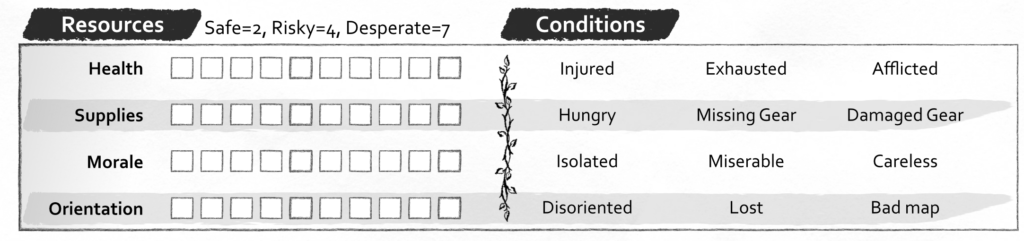
    An excerpt of the Far Lands team sheet showing the resources - Health, Supplies, Morale, and Orientation, plus a list of conditions for each
    Far Lands uses Health, Supplies, Morale, and Orientation as the resources. Though I’m actually in the process of playtesting a change to simplify this system down to a single track!

    This system has served me well in deciding when it’s time to head home from an event- am I out of gas, out of steam, or out of battery? The way I recover from those is very different! Out of gas I can stretch, drink water, eat some food. Out of battery I can step outside and get a moment of quiet. Check in with myself, do some solitary activity until I feel centered enough to re-engage. Out of steam, though, is often the what signals the end of the night, or just means I need to shift to a new activity. Many times I’ve found myself tired and disengaged, out of steam, but found myself having a conversation with someone about one of my passions and suddenly be reinvigorated.

    The only way this works is to check in with myself, to determine which I’m feeling and know how to respond. Like the spoon theory, I have a different amount of gas, steam, and battery each day, and different activities take a different amount of each, and like spoons sometimes they can be easier or harder to recharge.

    Expanding the theory

    I’ve been reading Structuring Life to Support Creativity, by Sandra Tayler, which has a lot of amazing advice and journaling exercises for creative folks. Some of those, I have found instantly useful. After taking some time to identify my priorities, personal values, and the core pillars of my life, one of the exercises had me list tasks and rank their cost on five categories: Willpower, decision fatigue, tracking, emotional burden/guilt, and anxiety. Another had me categorize tasks that refilled my creative energy or drained my creative energy.

    It’s always the case that some days leave you feeling more drained than others in energy, focus, creative juice, and passion. And some days might be draining in different ways. A day full of stressful news might leave me emotionally exhausted. A day of meetings might leave me socially exhausted. A day of solving complex technical puzzles might drain my creative energy.

    This system struck me as really similar to my Gas, Steam, and Battery theory, but it has a few more categories. I don’t have clever metaphors for those resources though. I’m going to have to keep thinking about how to poetically categorize the different types of mental energy that those represent!

    Refilling the well with intentional rest

    Putting the pieces above together, moving forward I want to build in for myself periods of intentional rest. I mentioned above that it was hard to enjoy things because I felt like I was falling behind on my goal. But in the same way, it was hard to rest and refill my creative well, my spoons, my battery, my steam, because I felt a degree of guilt and/or shame that I was leaving some work un-done.

    So instead, I’m making an alternate “win condition” for my daily goal. Either make progress, or intentionally rest. And some days are going to be set aside for one or the other, based on what I feel I need. One day I might decide to do more because I’m energized to work, but one day I might designate as a rest day because I’m feeling burned out.

    But what is intentional rest?

    Intentional rest is distinguished from unintentional rest. Which is to say, not accidental, and with a set intention. It’s different from just taking a break, because while that can give a needed respite from an intense or boring activity, it can often lead you to activities that don’t really recharge you. And often these breaks can feel like a failure, like something shameful. But with intentional rest, you are setting yourself up for success, because it has a goal.

    Imagine dedicating yourself fully to rest. Lower the lights. Put on comfy clothes. Get warm. Make your favorite tea. Settle down with a book or a show. Whatever you do may be mindful or mindless- whatever works best for you to refill. But the important thing is to acknowledge that this will help you achieve your other goals. This rest isn’t an embarrassing failure, it isn’t something you’re forced into by running yourself ragged, and it isn’t a shameful indulgence. It is strategic and necessary (to quote Everything Everywhere All at Once).

    Self care, as I have been trying to internalize for quite some time, isn’t selfish when it helps prepare you to care for others and fulfill your other responsibilities.

    Customize your rest

    Eating well, sleeping well, chatting with friends, whatever mindfulness practice you care to implement, different activities recharge different types of energy. And you can build your rest time with that in mind. Consider for yourself which activities cost you the most of your different types of energy, and which activities replenish different types of energy.

    A lot of activities will have a cost in one type of energy but replenish a different type! Hanging out with friends costs me social energy, but replenishes my creative energy, but writing is the opposite! I run low on creative energy… but get excited to talk about what I’m writing, so those activities complement one another perfectly!

    As a result, your personal intentional rest may not look like rest to an outside observer. For example, I find intense puzzle games very restful, despite requiring a lot of mental energy and focus. But because the stakes are low, it recharges me emotionally to deal with anxiety and difficult decisions. Running costs me physical energy but recharges my focus. Doing chores diffuses anxious jitters but costs me some willpower to get started.

    What does your rest look like? How do you recharge different types of energy?


    Next month, I hope to report back with the approximate final page count of Far Lands, but currently it’s just over 100! That’s about half the length of Masks: A New Generation. I’m interested to see how much that changes as I go through the next stages!
  • Engaging with the Mechanics 2: White space and Green space

    Engaging with the Mechanics 2: White space and Green space

    This is part 2 of my series about making mechanics easier for players to engage with. For the previous part, check out part 1: Cognitive Load

    A few years ago, I sat down with to run Masks: A New Generation with a new group for the first time. After introducing the players to the basic mechanics and making characters, we got started. As things kept rolling along, the hero team confronted a giant robot terrorizing a city park, and I noticed one of the players, a veteran of Dungeons and Dragons, had barely spoken up in the fight. Shifting the spotlight, I asked them directly what they wanted to do to try to stop the robot. They looked at their sheet, at the list of, moves, and back at me, and said:

    “I don’t know. What can I do?”

    This is a difficult spot as both a GM and a player. If you have ever asked your players “what do you do next?” only to get blank stares, you know how this feels. “Anything you want,” is not a helpful answer. In a Dungeons and Dragons style of game, players might have an explicit list of skills and abilities.

    But in a Powered by the Apocalypse game like Masks, your choices are left totally open. Instead, the moves are written to trigger based on the narrative situation within the game. You can’t simply choose from a list, you have to invent a course of action, and then see what move, if any, is most relevant. And to a player used to a more constrained set of options, this wide-open decision space was paralyzing!

    I’ve grown a lot as a game master since then, and in hindsight, I could have done a better job presenting courses of action (the robot is about to stomp on an ice-cream truck! A building nearby is in danger of collapsing!) But this experience is what lead me to recognize a critical difference in design philosophy that has shaped how I design and run games ever since.

    What is white space?

    This space was left blank on purpose

    White space in design is, quite simply, where there is nothing written. Not just blank space on the page (though this may be the case), but also where there are gaps in the rules or setting. You can see this most clearly in any well-written setting book or adventure module. If the designer knows what they’re doing, they’ll intentionally leave gaps for the players (the GM is also a player) to make it their own at the table.

    But in designing rules and systems, it can be a bit harder to notice.

    Out-of-scope whitespace

    There are a few places you can spot white space in a design. The most obvious is around the edges, outside the scope of what the game is about. Because a game or an adventure is finite, there will always be things left out. Deciding what to leave unwritten can be easy: You don’t need sailing rules in a game set in a desert. You don’t need to explain what’s on a continent across the sea in a module set in a single city.

    Sometimes, though, a designer will leave a gap in the design that is surrounded by content. A space where something should be, but there is nothing. And those decisions can be much more difficult, and much harder to use effectively.

    So why do we do it? And why is it so important?

    Why leave it blank on purpose?

    We hammer wood for a house, but it is the inner space that makes it livable

    Tao Te Ching, translated by Stephen Mitchell, chapter 11

    The high-minded philosophical reason

    When designing a game, it’s easy to take on the view that the rules are the game. That the players at the table will execute on the rules, and in so doing, experience the game as intended. But there’s something fundamental missing from that perspective.

    I mentioned previously that white space lets players tune a setting or a game to their individual group and preferences. But that’s something of an understatement: White space is what is unique about tabletop role-playing games. Without it, you have not created a tabletop role-playing game; You’ve created a board game. It may have random elements, or choices to make, but every option would be proscribed.

    Rules in TTRPGs are different from rules in a board game. Rules are generally clear and rigid, but TTRPGs are flexible and open to interpretation by design. It’s not the rules that are the game, it’s what happens in-between the rules. It’s the conversation.

    The rules in a TTRPG are not a merely set of steps to execute, they are sturdy skeleton that supports the wobbly organic bits in-between. They are a vessel that shapes and contains the fluid conversation that pours out of the players.

    The blank space you leave within your game is what defines the shape of the game. The part of the game that is not written in the book is the part that is played. And discovering what fills that empty space is a large part of why we play.

    Your job as a designer is to structure the conversation so that engaging with it will create the experience that you’re inspired to share

    Nathan D. Paoletta, RPG Design Zine

    Example: Character sheets

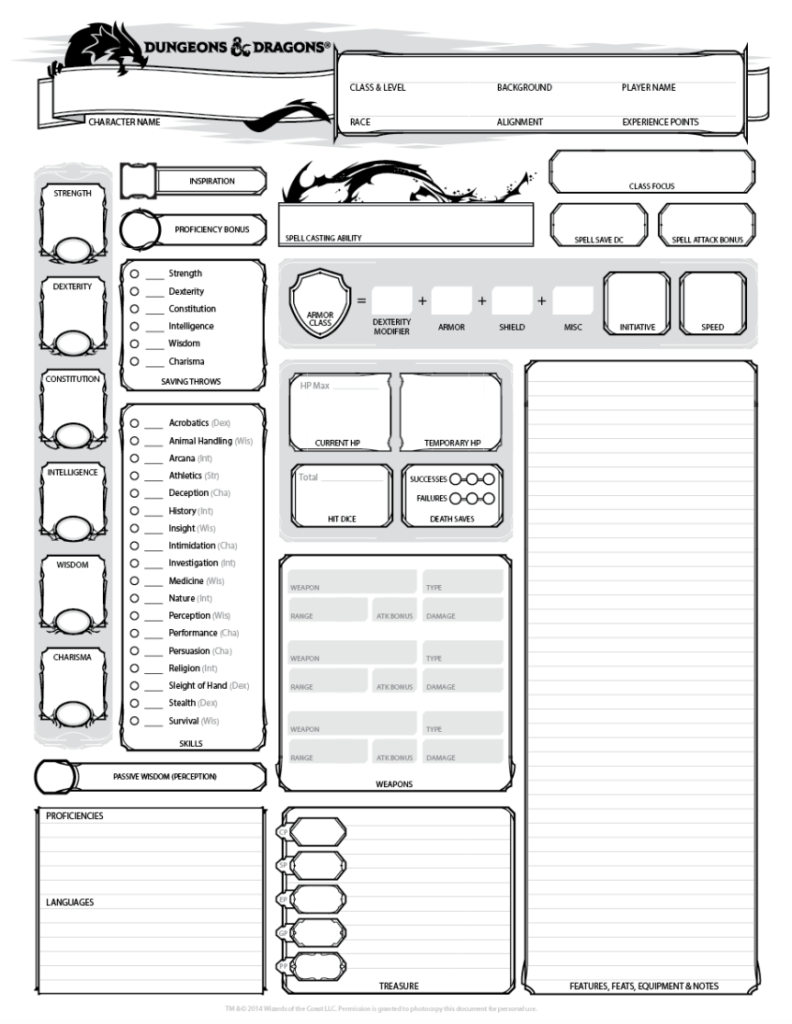
    For a concrete example, think of the spaces that are blank on a character sheet:

    The official Dungeons and Dragons 5e character sheet.
    Look how much of this sheet is just lined paper

    The name, stats, abilities, these are all degrees of freedom in the design of a character because they are left blank on the sheet. But even there, there are rules for how those are to be filled in. But look closer on many sheets and you will see something that doesn’t have rules associated with it: a box with lines for notes, character details, backstory, personality, and so on. Things that go beyond and between the rules to explain why and how this character is the way they are.

    Even on sheets that don’t have this feature, (Powered by the Apocalypse games are frequently guilty of this), I’ll see players adding notes into margins, the back of the sheet, or even a separate page that explain the details of their character that aren’t enforced or even supported by any game system.

    This blank space is what lets a player feel they own and inhabit a character. Even games have characters already defined for you, like Yazeeba’s Bed and Breakfast, have blank space to fill in as you explore the characters through play.

    The Practical Reasons

    Well-crafted white space is in ttrpg design has very practical benefits:

    White space allows for customization. While choosing from a list is quick and easy, there’s nothing that provides more freedom in a design than allowing a player to make up whatever they want (within reason & the bounds of the game) to fill a space. Like with character sheets and settings as described above, when something is left unwritten by the designer, it falls to the players to write it. And the players at the table can often (but not always) come up with an answer that is better for their specific table than a designer trying to make an answer that works for every table could.

    White space gets buy-in. When you’ve had the chance to create part of a character, the world, or part of the game system, you naturally feel a sense of ownership over it. You’re intimately familiar with that part of the game because you had a hand in creating it. You feel authority to make decisions about that part of the game. You feel invested in seeing what happens to it next. This is why collaborative worldbuilding at the start of an RPG is so powerful, but it can work the same magic in so many other places.

    White space gets you thinking. There’s something compelling about the space on the map that just says “here there be monsters.” The thrill of curiosity and discovery is a huge part of what drives people to play TTRPGs. Just like I mentioned about customization above, the blank space naturally prompts players to imagine what could fill that space. What could possibly explain everything surrounding that gap? To use Blades in the Dark as an example, Lord Scurlock is presented as a mysterious, seemingly-immortal figure whose personal influence is so powerful that he is on an even playing field with some of the most powerful factions in the city. But exactly what he is or what he wants is left totally ambiguous. As a result, the players almost always want to find out, and the GM gets to have fun crafting his sinister plot. As a result, everyone at the table is engaged.

    Putting it all together

    There’s a rule in horror that the moment you show a monster to the audience, it instantly loses its emotional power over them. When you can’t see it, you’re forced to imagine what it could be. And what each individual imagines is going to be more powerful than anything a writer could come up with or an artist could create.

    As long as the space is left blank, the audience/player is compelled to engage, to imagine what could be there. Everyone has their own monster, and the monster can be different every time. That’s the magic of white space.

    The Catch

    Unfortunately, there’s a big problem with white space. It turns out, can sometimes be really hard to think of an idea on the spot that’s as cool and interesting as you’d like. Sometimes, it feels like breathing. There’s an obvious answer, or, even better, one that violates expectations in an exciting way. But sometimes it feels like being thrust into the spotlight on stage without knowing any of the lines. Like sitting down for test without studying.

    Experience helps, but the experience is still highly variable even for the most skilled improvisers. So why is it sometimes so stressful, but sometimes it feels so natural?

    Planting seeds: How make white space green

    The secret to making white space work is planting seeds. Prompting players so that by the time they’re asked a question, they already have ideas for the answer. Immersing them in the vibes of the game. Showing them the shape of the gap in the puzzle so they know how to craft the missing piece.

    This is green space. Rather than a barren field, the blank space is crafted into fertile soil for ideas to grow. What might look like an empty field actually has seeds of ideas already planted under the surface.

    Example: For the Queen

    The best example of this I’ve ever seen is For the Queen, by Alex Roberts. For the Queen takes the form of a set of cards, each of which has a simple prompt. It begins with the players being told “The queen has chosen you for this mission because she knows you love her.” Players take turns going around the table drawing a card and answering the prompt on it. At the end of the game, everyone responds to the prompt: “The queen is under attack. Do you defend her?”

    I was deeply skeptical of this game when I first heard that premise. Surely, I thought, if the cards are the same, even in a different order, the game would play out largely the same way every time! But I could not have been more wrong. Even though the seeds planted by the designer are the same every time the players sit down to play, they will grow differently every game.

    I had overlooked an important part of the game. I hadn’t noticed what was missing: For the Queen has zero character creation. The characters are completely blank at the start of the game. Even the eponymous Queen, though you may have a piece of art to inspire you, is a totally blank slate. As I said in a earlier, the part of the game that is unwritten is what part that is played. The characters are left blank, so the game is about discovering who they characters are.

    But how does this work? How could you create a character from a completely blank slate with no rules to guide you? When designing the prompts, Alex Roberts had the mantra: “Tell them something they don’t know, then ask them a question about it.” That simple mantra is an incredibly powerful tool for game design, and it’s the secret to making white space into green space.

    Why are some others at the royal court jealous of your relationship with the queen?
    A sample card from For the Queen

    For example, the prompt on this card might look totally open-ended at first, but it actually tells you a great deal: You have a special relationship with the queen, it is known to others, and those others are envious of that relationship, so it must be worthy of envy. But it doesn’t tell you anything about what that relationship is.

    The card above brilliantly hides the prompt within a question. It buries the seed, making the hand of the designer invisible while constraining the space of answers to the question. The player no longer has to decide if the relationship is good or bad, or if it’s secret or public. The prompt feels completely open. But when the player starts to answer that question, their answer will naturally fall within the constraints created by the premise of the question. The result will feel as though it is completely their idea.

    And yet the player is never alone in crafting their answer to the prompt. They’re guided by the prompt, by the previous answers they’ve given, and by the very premise of the game (the Queen chose you because she knows you love her, after all).

    Consider the alternative cases:

    • What is your relationship with the queen?
    • Some others at the royal court are jealous of your relationship with the queen.

    In the first case, the question feels absolutely impossible to answer, especially if it’s the first card you draw! It’s so wide open, there’s nothing to latch on to. There’s no seed crystal to grow your idea off of.

    But in the second case, a player would likely feel they’re being dictated to. This is the way it is- no room for debate! Simply accept the premise and move on.

    But when both are put together, the magic happens.

    The takeaway: Ask leading questions

    The secret is leading questions. I was first introduced to the power of this idea at a seminar at GenCon, and it’s totally changed the way I GM. Whenever you have the chance to ask an open-ended question, you can gently constrain the answers to prompt the other players with ideas for how to answer. If you practice this skill, it will make your a better designer and a better game master.

    This instantly fixes the “what do you do next?” problem. To steal an example from that GenCon seminar, instead of asking “what do you do next” until the plot advances, decide on something that would advance the plot, and ask the players a question about that.

    Instead of “what do you do before the party,” ask “How long do you wait before arriving at the party? How do you get there?” Is this railroading? No. Because players love to be contrarian, and just as easily as it might prompt the players to answer the question you asked, it might prompt them to say “what if we don’t show up at all?” But that answer still moves the narrative forward.

    In the Masks example I gave right at the start, I might have said: “The robot is barreling out of control towards a group of civilians. What do you do to stop it?” The player might choose to prioritize something else, but by doing so they are making a major decision about the direction of the narrative.

    No matter the situation, tell them something they don’t know, then ask them a question about it.

    Expert mode: Begging the question

    A leading question doesn’t necessarily have to be a literal question. In fact, the most challenging but rewarding way to make this happen is to get the players to ask the question themselves. To make this work, you have to beg the question.

    To make this work, you need two things:

    Craft a compelling hook. Present the players with something so compelling and mysterious that they simply must engage with it. Enough details that they can easily imagine what might go there. This is the seed that the players’ ideas will grow from

    Then, resist the urge to explain. It’s so challenging as a designer to leave those spaces blank because we get pulled by our curiosity to fill it in just as strongly as the players, if not more. But you need to leave enough blank space to fit a wide variety of options.

    For example, in Wanderhome, by Jay Dragon, one of the items the Ragamuffin could start with is “The Heavenblade, lost after slaying the Slobbering God, that you would never use to hurt another soul.” This immediately prompts questions: What is the Heavenblade? What was the Slobbering God? How did you of all people end up with it?

    If you fill your game with interesting hooks, but leave them unexplained, like the horror movie monster, players will be compelled to imagine what fills that space. And whatever they come up with will be better for them in that moment than anything you could write.

    This is how you plant seeds. This is what makes your white space into green space.