I’m very rapidly approaching the point with Far Lands where I have to start thinking about crowdfunding, which is terrifying. But these final stages are forcing me to reckon with the tasks that I’ve been putting off. Namely, finishing up the sample of play.
I knew from the start that I was going to need examples of play, but I had no idea how to write them. This was because of a simple problem: I don’t usually read them! The vast majority of ttrpg books I have read have samples of play in them, but I have always just skimmed over them at most.
So I sat down to read. I looked through my collection of RPG books and read as many samples of play as I could. From my research, I discovered three types of play samples I needed for the book: short-form, long-form, and narrative.
Short-form
Short snippets alongside the core mechanics that demonstrate them for the reader. Include these wherever you have any more complex mechanics. I actually didn’t end up needing too many of these, but they’re very important. They were not too hard to write, either- they just had to be succinct and clear.
Long-form
A longer narrative that demonstrates big-picture structure and gameplay loop. Long-form samples of play show the designer’s vision of how the game is played. Where the short-form samples show the mechanics in isolation, these demonstrate how all of the mechanics interact in context. This was by far the hardest to write, and I’m going to break down why in the next section.
Narrative
Narrative samples are short fiction set within the world of the game. They don’t reference the mechanics of the game at all. Instead, they set the tone and present the setting. In my case, I framed these as text written by explorers from within the worlds of Far Lands games I’ve played. I tried to make each journal entry very distinct from the others. I wanted to show the types of stories the game is built to tell. I wanted to broaden the reader’s horizons of what types of worlds they can explore.
Long-form sample of play
The long-form sample was by far the hardest part of writing the book. During the process, I had to completely scrap and re-write it from scratch using the lessons I learned from the first attempt.
The First attempt
My first attempt was well-intentioned but, in the end, misguided. My highest priority in this was authenticity. I wanted to capture natural-feeling dialog. I found a lot of demonstrative dialog writing very stilted and unnatural, and I had a plan to avoid that fate.
I got a group of friends together and, with everyone’s permission, recorded an actual game. My reasoning was that I could use snippets from that game throughout the book as examples of how that section flows.
After the game, I listened through the recording and transcribed it. It was not too difficult, though it did take quite some time. During that process, I editorialized, cutting out table talk, streamlining the back-and-forth, and inserting narration to describe the game actions we took.
Only once I had fully written out that sample of play and shared a copy of the current draft of the book for feedback did I realize the problem: The game didn’t make any sense to people who weren’t at that table!
All of us at the table had gotten really into the game and forgotten that it was intended to be used for teaching! We were all experienced players, so we hadn’t thought to keep things simple. We had built a world-within-a-world where we were hackers and researchers from a cyberpunk world exploring a simulation of heroic fantasy animals. The world we created was fun to explore, and we told a story with some real emotional weight for us at the table, but was very confusing for for readers.
So I went back to the drawing board. I still wanted something real, but also something easier to control and much smaller in scope.
The solo game
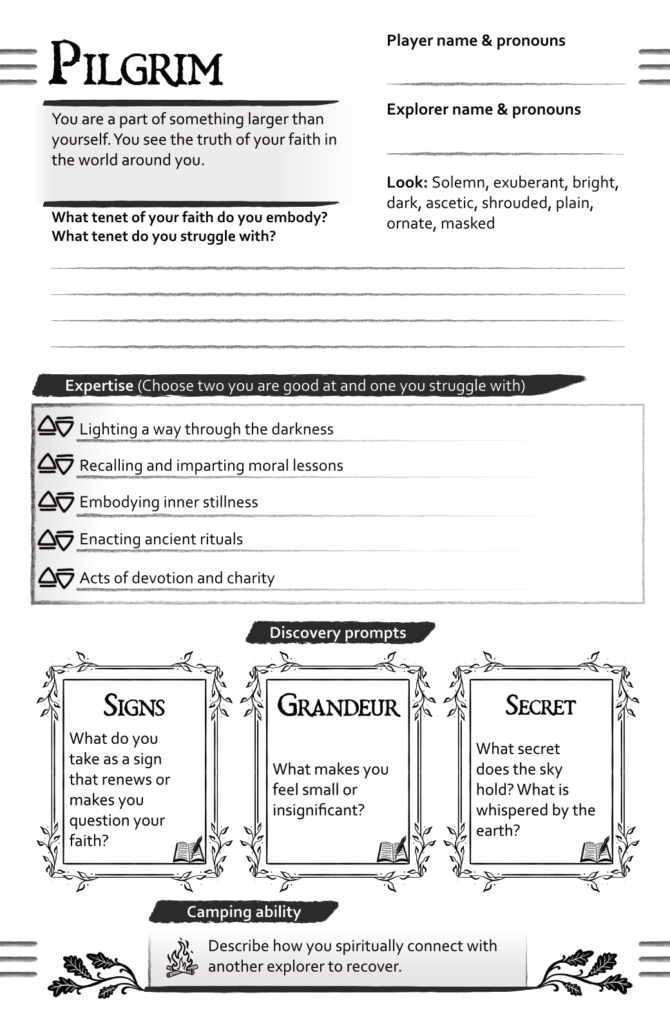
I had to do something different. Taking what I had learned from our first attempt, I used the three example explorers from the book to play a solo game. I’ve played a lot of solo games of Far Lands throughout the development process, but it felt different when I knew other people would read the results, not just me.
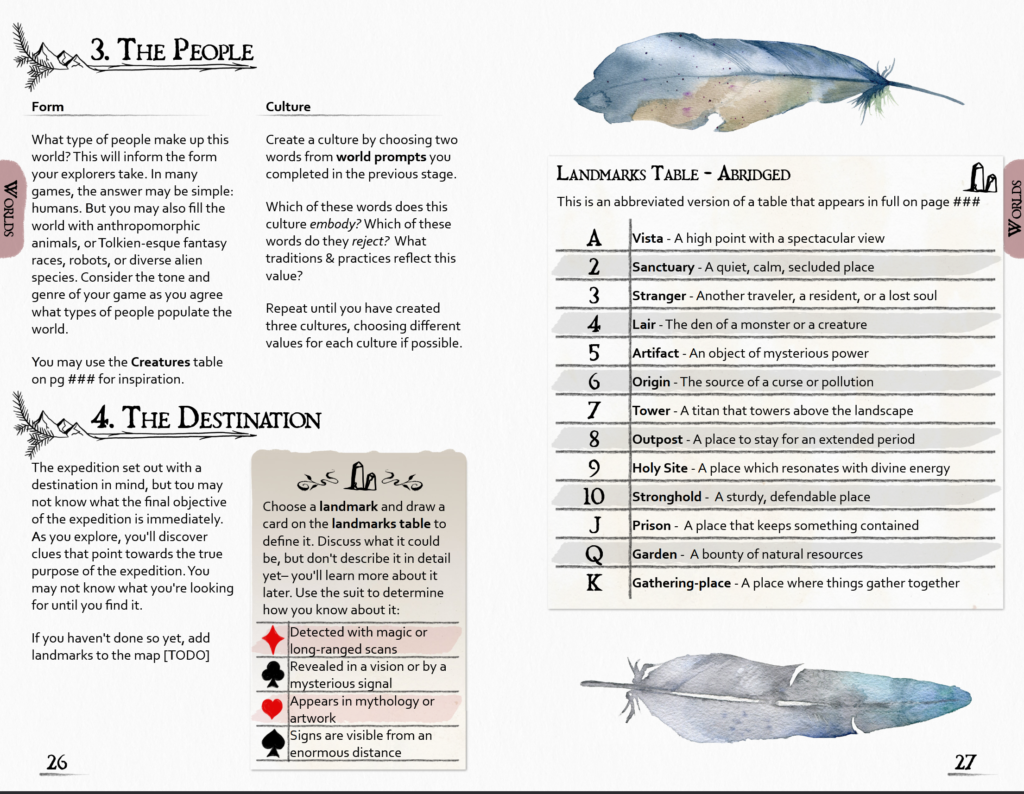
Because I was playing a solo game, I was able to shape the game to fit my goal of demonstrating the mechanics. I played the game mostly faithfully. The card flips for the random tables were kept random but I fudged some draws to ensure I encountered a complication and a storm. This way, I didn’t have to wait for those to happen naturally, which let me keep the example succinct.
And to keep dialog natural, I was able to transcribe my own internal dialog as I worked through ideas as a conversation between hypothetical players. It isn’t perfect- it is still more stilted than the natural conversations I had transcribed from a real game, but it is much more succinct.
Quite frankly, it still needs work. I’ve formatted it with distinct sections for table talk, written journal entries, and meta-textual rules references, but I need to apply the formatting more consistently. More importantly though, it is currently 27 pages long- Much more than I need! Most likely, I will trim the current sample down to just the first of three days of travel and a short excerpt from the last day, and provide the sample of play as a free PDF.
Secret fourth thing
I said earlier that there were three types of samples of play I needed- that was a lie! There is a secret fourth type that I omitted because it does not appear in the book, but it is just as if not more important: The actual play. These are extremely important to how players understand a new game. I rely on them to learn new games myself!
Fortunately, I was lucky enough to meet the amazing folks over at Open the Gates Gaming to stream some gameplay with them, and they gave me permission to use the videos.
Check them out!