Last month, I wrote about how I had completed more than half of the work that I expected me to take all year. As of today, I’ve I’m almost completely done with my initial layout pass! All that’s left is the long-form sample of play and the appendix. But there’s still a lot left to be done after this initial pass! Alignment, consistency, copy-editing, and accessibility are all extremely important.
This post is going to be shorter because it’s a short month, and also because I’m going getting ready for some travel. But I still want to share some of what I’ve learned this month in work on Far Lands
What I missed
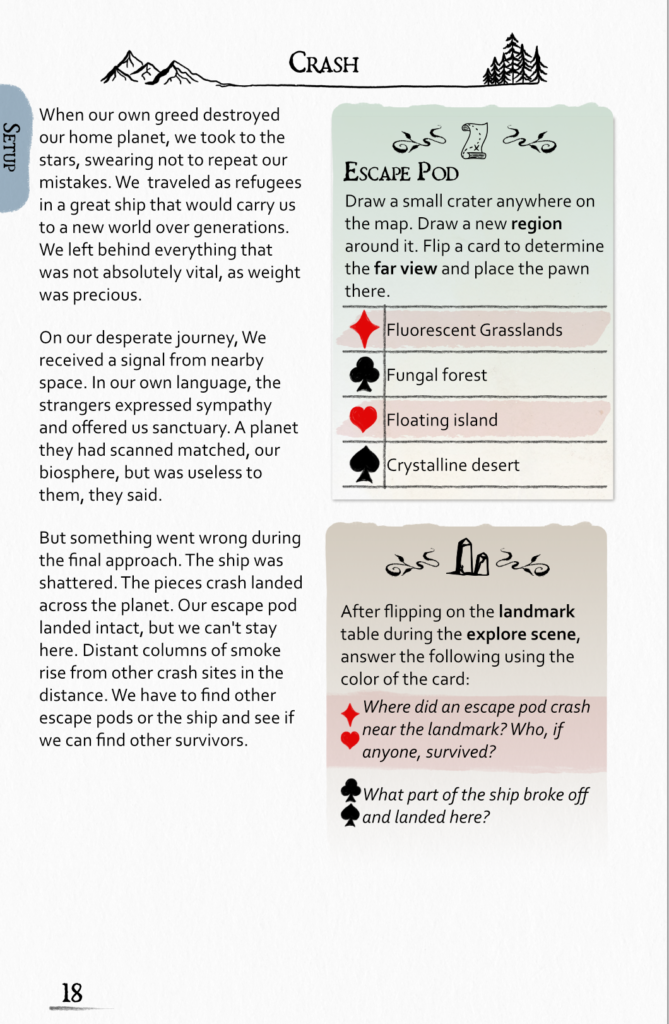
Doing layout for Far Lands has forced me to reckon with every single word I wrote, and it’s been revelatory. I have noticed a lot of gaps in the manuscript I had totally missed. Tables with empty slots, TODOs I’d forgotten, paragraphs that I’d intended to re-write. I am very grateful that this process has forced me to look over every single part of the game. If I had passed it off to someone else at this point, those gaps could have presented a real problem!
I talked last month about using white space in your game design, but this space was not intentionally left blank. Oops! But it’s been exciting to re-engage with the game design part of the process
Leaving the best (worst) for last
When I started, I laid out my plan for the year, putting things in an order that I felt made sense to me. That order changed a bit as I went, but I realized at some point that I had put them in order of my confidence.This helped in some ways… and hindered me in others.
The first sections I laid out I was very confident in the text, the rules, and had a clear vision of the layout. This really helped me build my familiarity with the tools. I was able to implement my vision without worrying about having to edit the text too much. By the time I got to the more challenging sections, I already familiar with the tools and the style of the book. As a result, the work shifted from figuring out a visual identity to figuring out how to organize a challenging text.
But it’s also meant that as I go, I’m feeling more tentative about the text. I knew the narrative journal entries were going to have to be edited for length to fit on a page. I knew some of the scenarios needed content filled in. I knew some of the tables were going to be challenging to make readable. And so the work got harder to engage with. So I needed to give myself a bit more grace. Which brings me to my next point:
Don’t push too hard
I talked in my previous far lands update about weaponizing my perfectionism to make steady, incremental progress. I mentioned that I was worried I would push myself to burnout. I’ve been continuing to approach this system cautiously, and as expected, I started running into the limits. Some days, I just end up fully booked with things that are very important to me. Trying to push through to get just a little bit done will keep me up too late or pull me away from stuff I will really miss if I have to decline. And on those days, knowing that I haven’t gotten it done weighs on me all day. It prevents me from fully enjoying stuff I know I could otherwise enjoy more!
And what I realized is it’s not hard to see those days coming- from looking at my calendar, it’s not hard to know what days I’m going to struggle to fit it in time-wise. So I can designate a day when the reminder doesn’t pop up and know that’s a “rest day.” Or more realistically, otherwise occupied. Because it’s not really a rest day. And that’s kind of a problem…
Gas, Steam, and Battery
There’s a theory that I’ve seen a lot about how do deal with limited energy called spoon theory. A lot of folks may be aware of it already, but it breaks down to the metaphor that each day you have a limited amount of metaphorical spoons. Each task costs a spoon, sometimes more than one if it’s a hard task! And every day you have a different number. It’s a practical metaphor that really helps conceptualize how you’re spending your energy and how much energy different tasks take.
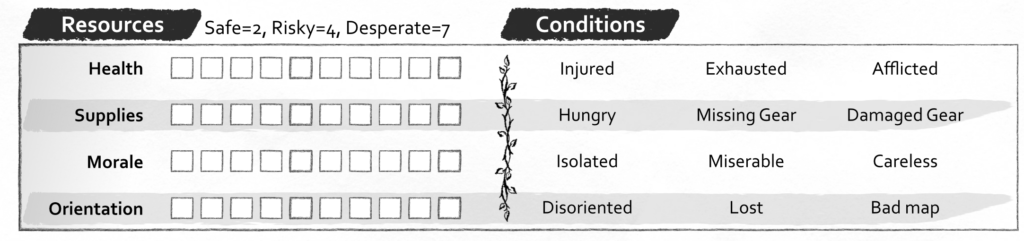
I have a personal distinction I like to make between three different kinds of tired: Out of gas, out of steam, and out of battery. They map pretty well to classic TTRPG stats (and philosophy, but we’re here to talk about ttrpgs) of body, mind, and spirit,
Out of gas is physical exhaustion. You may want to keep going, but your body says no. This could be in the form of tired muscles, your natural circadian rhythm telling you it’s time to sleep, or the body shutting down when you’ve carried too much stress for too long.
Out of steam is mental exhaustion. You are out of willpower, have no more drive to continue. Whatever you’re doing isn’t fun anymore, and any effort you put in is going to be halfhearted or pull from internal reserves that borrow from tomorrow. It’s hard to make choices or take decisive action.
Out of battery is social or sensory exhaustion. You don’t have the battery left to engage with people in the way you want to. Conversations get hard to follow and it’s easy to get overwhelmed or confused. You may still want to be around people and be interested in what’s going on, but just don’t have whatever it is you need to comport yourself or keep yourself together in the moment.
This system has served me well in deciding when it’s time to head home from an event- am I out of gas, out of steam, or out of battery? The way I recover from those is very different! Out of gas I can stretch, drink water, eat some food. Out of battery I can step outside and get a moment of quiet. Check in with myself, do some solitary activity until I feel centered enough to re-engage. Out of steam, though, is often the what signals the end of the night, or just means I need to shift to a new activity. Many times I’ve found myself tired and disengaged, out of steam, but found myself having a conversation with someone about one of my passions and suddenly be reinvigorated.
The only way this works is to check in with myself, to determine which I’m feeling and know how to respond. Like the spoon theory, I have a different amount of gas, steam, and battery each day, and different activities take a different amount of each, and like spoons sometimes they can be easier or harder to recharge.
Expanding the theory
I’ve been reading Structuring Life to Support Creativity, by Sandra Tayler, which has a lot of amazing advice and journaling exercises for creative folks. Some of those, I have found instantly useful. After taking some time to identify my priorities, personal values, and the core pillars of my life, one of the exercises had me list tasks and rank their cost on five categories: Willpower, decision fatigue, tracking, emotional burden/guilt, and anxiety. Another had me categorize tasks that refilled my creative energy or drained my creative energy.
It’s always the case that some days leave you feeling more drained than others in energy, focus, creative juice, and passion. And some days might be draining in different ways. A day full of stressful news might leave me emotionally exhausted. A day of meetings might leave me socially exhausted. A day of solving complex technical puzzles might drain my creative energy.
This system struck me as really similar to my Gas, Steam, and Battery theory, but it has a few more categories. I don’t have clever metaphors for those resources though. I’m going to have to keep thinking about how to poetically categorize the different types of mental energy that those represent!
Refilling the well with intentional rest
Putting the pieces above together, moving forward I want to build in for myself periods of intentional rest. I mentioned above that it was hard to enjoy things because I felt like I was falling behind on my goal. But in the same way, it was hard to rest and refill my creative well, my spoons, my battery, my steam, because I felt a degree of guilt and/or shame that I was leaving some work un-done.
So instead, I’m making an alternate “win condition” for my daily goal. Either make progress, or intentionally rest. And some days are going to be set aside for one or the other, based on what I feel I need. One day I might decide to do more because I’m energized to work, but one day I might designate as a rest day because I’m feeling burned out.
But what is intentional rest?
Intentional rest is distinguished from unintentional rest. Which is to say, not accidental, and with a set intention. It’s different from just taking a break, because while that can give a needed respite from an intense or boring activity, it can often lead you to activities that don’t really recharge you. And often these breaks can feel like a failure, like something shameful. But with intentional rest, you are setting yourself up for success, because it has a goal.
Imagine dedicating yourself fully to rest. Lower the lights. Put on comfy clothes. Get warm. Make your favorite tea. Settle down with a book or a show. Whatever you do may be mindful or mindless- whatever works best for you to refill. But the important thing is to acknowledge that this will help you achieve your other goals. This rest isn’t an embarrassing failure, it isn’t something you’re forced into by running yourself ragged, and it isn’t a shameful indulgence. It is strategic and necessary (to quote Everything Everywhere All at Once).
Self care, as I have been trying to internalize for quite some time, isn’t selfish when it helps prepare you to care for others and fulfill your other responsibilities.
Customize your rest
Eating well, sleeping well, chatting with friends, whatever mindfulness practice you care to implement, different activities recharge different types of energy. And you can build your rest time with that in mind. Consider for yourself which activities cost you the most of your different types of energy, and which activities replenish different types of energy.
A lot of activities will have a cost in one type of energy but replenish a different type! Hanging out with friends costs me social energy, but replenishes my creative energy, but writing is the opposite! I run low on creative energy… but get excited to talk about what I’m writing, so those activities complement one another perfectly!
As a result, your personal intentional rest may not look like rest to an outside observer. For example, I find intense puzzle games very restful, despite requiring a lot of mental energy and focus. But because the stakes are low, it recharges me emotionally to deal with anxiety and difficult decisions. Running costs me physical energy but recharges my focus. Doing chores diffuses anxious jitters but costs me some willpower to get started.
What does your rest look like? How do you recharge different types of energy?
Next month, I hope to report back with the approximate final page count of Far Lands, but currently it’s just over 100! That’s about half the length of Masks: A New Generation. I’m interested to see how much that changes as I go through the next stages!