As we’re going into the new year, I’ve been thinking about resolutions. After a while of putting it off to work on other parts, over the last month, I’ve built up a good amount of momentum on layout for Far Lands!
I was nervous about doing layout myself- it’s a part of the process I’ve never done before, but after getting some practice with Affinity via the TTRPG Bookmark Jam and getting accepted to run the game at a local convention in my area, I decided to make it my resolution for next year to get the book laid out. I have a clear idea of visual style and I’ve gathered most of the assets and art I need. Now I just need to do the work!
To make the plan loose enough to adjust to unexpected life changes, I broke the book down into sections and distributed them by month. You can see I’m already ahead, which is great, though I don’t expect to stay that way. I gave more time than I thought I’d need to a lot of sections but I expect some sections will take a lot more time than others. By keeping myself accountable to get just a rough draft done each month, I hope to keep up the momentum I’m feeling right now without burning myself out.
Timeline
December 2025
Role sheets (Done!)
Sample explorers (Done!)
January 2026
Party sheet (Done!)
Order of Play handout (In progress)
Quick reference tables
February
Character creation
March
The Team
Getting Started
April
Exploring the world: Intro
Weather
Prologue scene
May
Exploration Scene
Near table
June
Discovery scene
Start challenge scene
July
Finish challenge scene
Look Ahead
Far table
August
Camping Scene
Memories and Connections table
Epilogue scene
September
Scenario template
Advanced setup
October
All scenarios
November
Journal entries
– Captain’s Log
– Fort Serendipity
– The Forge
– Spider-goats
December
Intro
Sample of play
Appendix
Sample pages
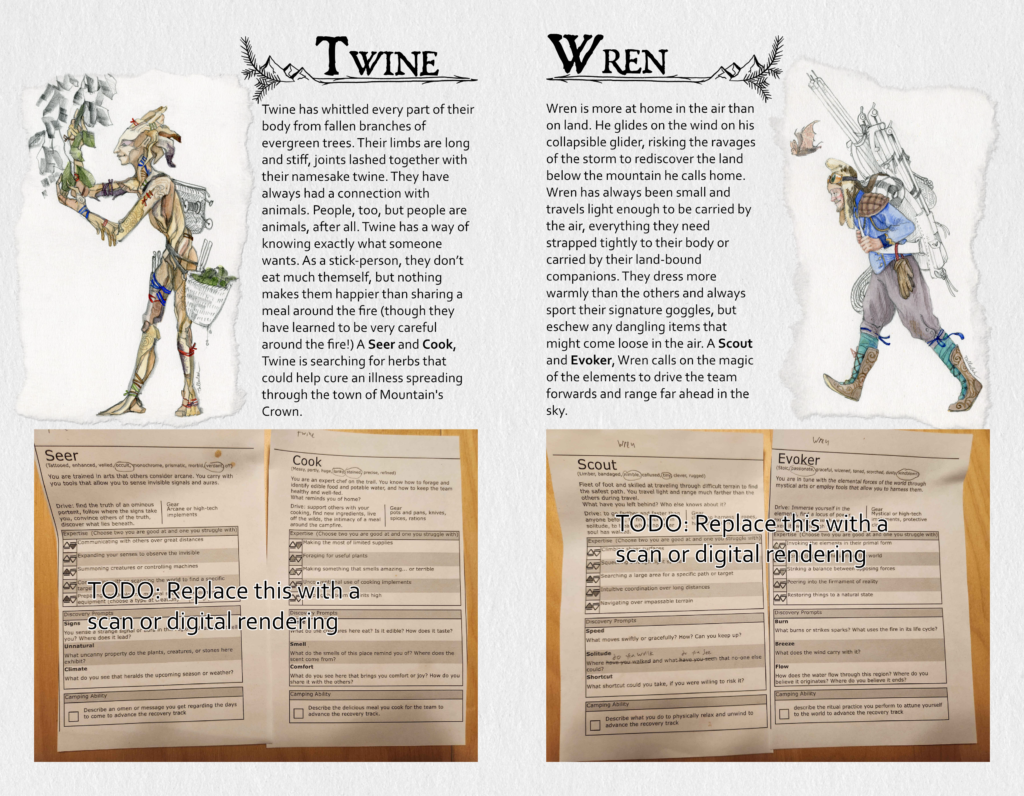
Check out what I’ve got so far for my sample explorers pages! This is pretty rough- I’m planning to rewrite the descriptions to fit the space better and I need to substitute in the new and improved role sheets. Featuring art by the amazing Tallulah Cunningham!
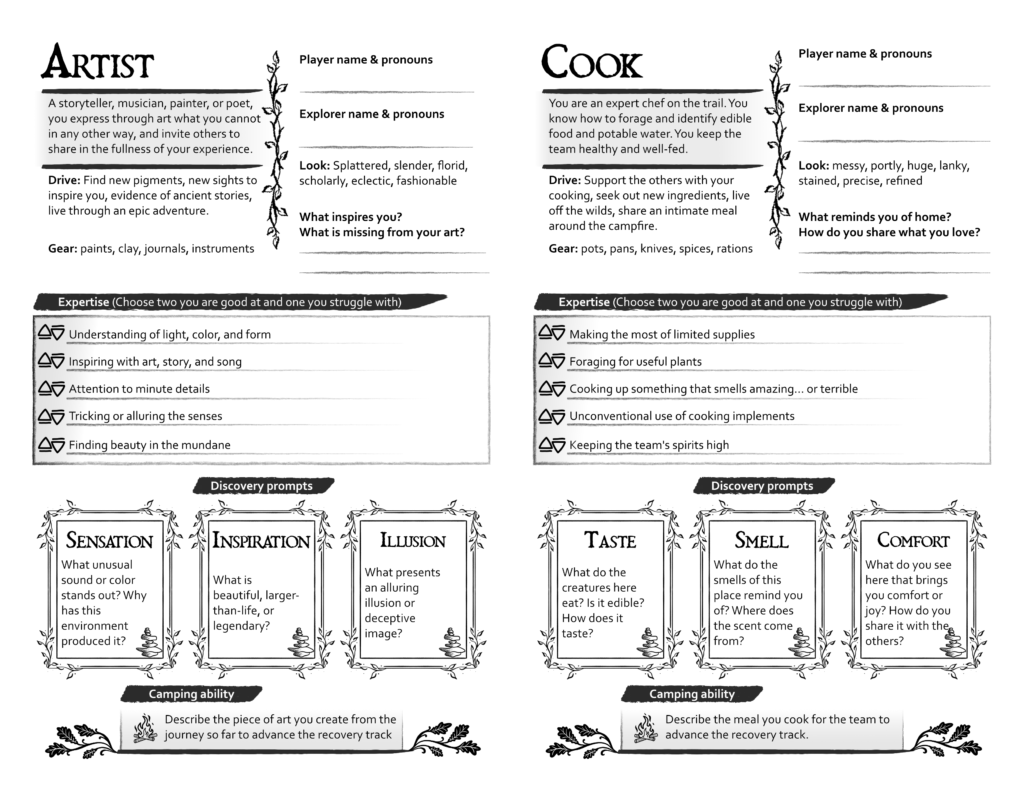
Speaking of the new-and-improved role sheets, here are a few samples of what those look like now, featuring a few assets by Alderdoodle! I still need to do a playtest with these to see how they feel in play (I almost certainly need more space to answer the character prompts) but they already feel so much nicer than the old ashcan version.
I’ll try to keep posting updates as I go- at least monthly as I check off various sections
What I’ve learned
Affinity is awesome
It turns out Affinity is a fantastic tool for what I want to do. The “Master Pages” feature makes it so easy to create a template for a certain type of page (such as a character sheet) and apply changes to all of them at once! But I’ve also learned that tables in Affinity are… wonky. In some cases it may be easier to just line up the boxes manually, and the vertical / horizontal align tools are so, so useful now that I’ve actually found where those live.
Lower the stakes at the start to build momentum
But most importantly, I’ve learned a big lesson about perfectionism. I was genuinely afraid to get started on this part of the project because I worried I wasn’t going to be able to make it look as good as I imagined, but also afraid to let go of control of it and spend the money to hire someone to do it. I’ve seen time and time again the mantra “First make it exist, make it good later,” and that’s a lot easier to say than to internalize. But what really helped me was to lower the stakes.
Instead of jumping right into the deep end learning the basics of the tools with Far Lands, I joined a game jam I knew I could knock something out for relatively quickly. Something with a deadline, that I didn’t have the same huge level of emotional attachment to. That way, I could feel safe to make mistakes without feeling the emotional burden of failing to live up to my high expectations for myself. And by doing that, I and discovered it wasn’t that hard to create something that looks how I imagine. And making mistakes on the first pass turns out to not really have consequences because I can keep revising it later. All this and reminding myself of the excitement I get from taking an idea and making it real has made it so, so much easier to take the next step. And I’m so excited to see what’s next.
Leave a Reply